Showing posts with label bracken. Show all posts

Sunday, 10 March 2019

Mild winter, early Spring

Looking back over previous posts it seems I write about the appearance of the wild daffodils every year. That's because they are such an obvious sign of the coming Spring. This year they are earlier than ever. The first ones and twos were in bloom on 3rd March, with lots of flowers a week later. In 2016 and 2017 the daffodils weren't in bloom until the third week of March. That's a full two weeks early this year!

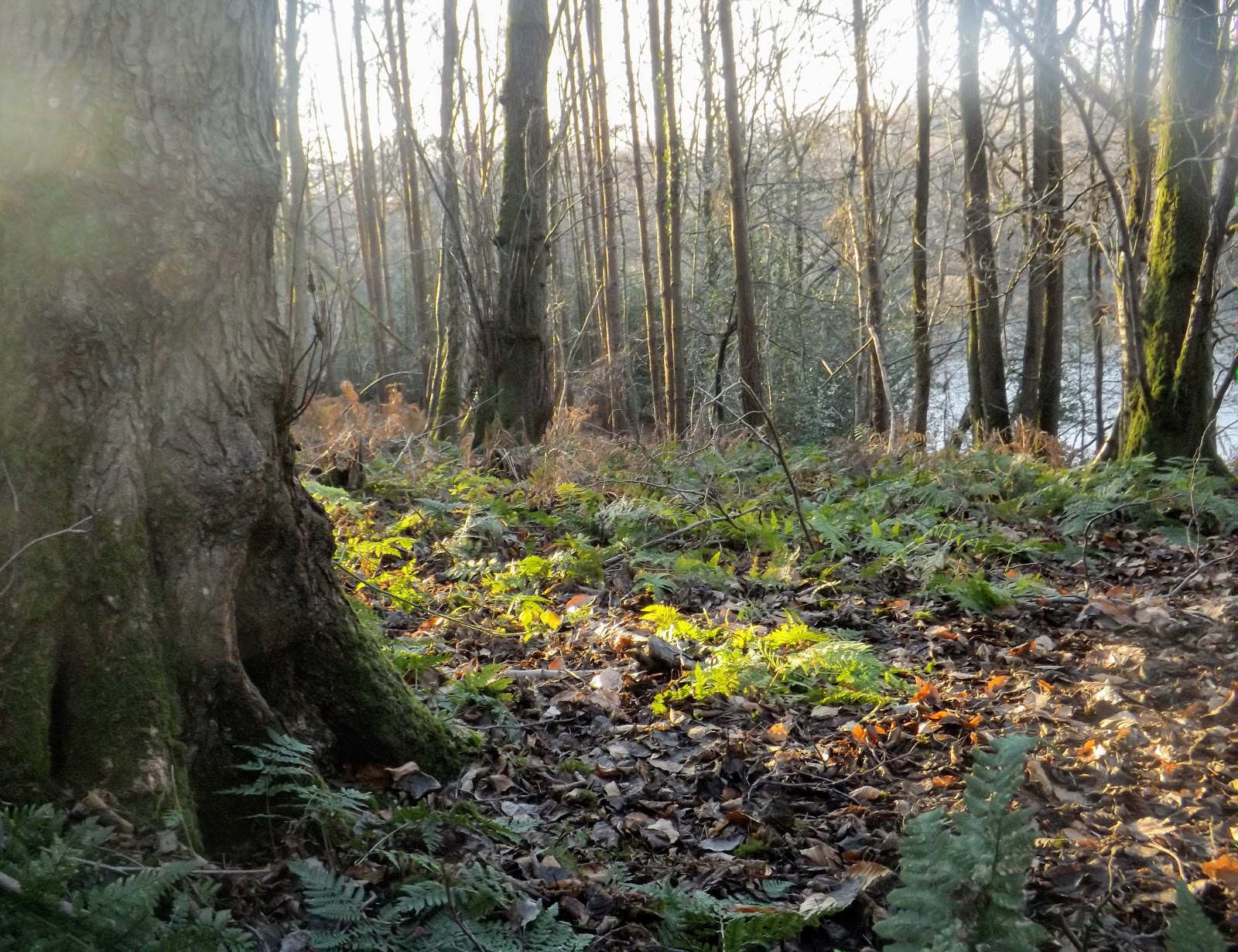
Winter was very mild, with only one small scattering of snow and maybe one frost. The result is that the wood does not have the 'flattened' look is usually has at this time of the year. The dead bracken has not been broken down by frost and crushed by snow. As a result the ground layer still has a high covering of dead material, when it's usually bare in early Spring. While offering protection for small mammals, this may mean that other regeneration will struggle for light this year as it will have to fight through this lot - see photo below.


All of this has been making us think about planting for climate change, and trying to decide how best to approach it. There is one school of thought which says that our native trees will adapt, and they will self select; the trees best genetically suited will survive. Other people suggest planting species which come from further south.  We're not planting for timber  - we want to restore our bit of ancient woodland and associated ground flora, so we're wary of introducing non native species, due to the potential effect it might have on the vegetation community.  So one route might be to plant tree types that exist in our woodland community - oaks, beech, rowan, birch, crabapple - but which have non native provenance. So we could look for trees of the same species which are generally grown further south - say in western France.

The danger is of course is that climate change is not just making our weather warmer, but more uncertain. So more southern trees would still have to be able to survive occasional but severe late frosts  - such as the one which killed off a  pot grown walnut we planted the winter before last  This technical paper suggests that planting a mixture of species will act as as an insurance. Which seems like common sense.

I suspect we'll take the cautious route: planting more native broadleaves to make the wood more diverse and trying out a few with non native provenance to see how they get on.


Monday, 21 January 2019

Busy January, working and looking.

A beautiful day. Cold but gloriously sunny. We started the day with  more  hedge planting along the roadside,  a project we began last winter.  The idea is to do a bit more each year until there is a substantial  barrier between the wood and the road, and then, when it has grown tall and thick enough, start laying it in the traditional way. It's all experimentation so we'll see how it goes. The hedging plants have done better at the northern end , not so well  at the south. Not sure why, perhaps because it's  shadier down there, and the ground is definitely worse, almost all sandstone and clay.


It's easier and faster to do this time around because we're not using rabbit spirals as there don't seem to be any rabbits, or bamboo canes as these don't seem to have much of a purpose. The plants appear to be doing fine without them. Plus, we're becoming tree and hedge planting experts!


There is quite a lot of  badly neglected hazel at the southern boundary . Originally planted for coppicing, it hasn't been touched for many years , and  branches have grown long, thin and tangled , bending in all directions, and over 30 feet in height.  Cutting will improve its health and strength. 

  
                                            Hazel before it is coppiced or pollarded


While ideally we would coppice them it's going to be almost impossible because the deer will eat all the emerging new shoots however much we try and protect them.  So, we'll  pollard the stems, i.e.  cut them at above deer munching height . At least this will add a different  height layer to the wood. The  Willow Grove which we started working on a few years ago, has been very successful in creating a much needed shrub layer for the wood. That project is ongoing , we are still felling birch there, and  will have to cut the pollard stems soon, but we are pleased with the results of our work. Luckily, hazel is much easier to cut than hard springy willow, so it shouldn't take us too long to get the job done.
.
Pollarded hazel, surrounded by the cut tops, to keep the deer from eating the new Spring shoots
.
                                            Part of the pollarded Willow Grove in winter.


At this time of the year. the wide paths made by the machinery during the Scots Pine plantation thin in late 2015 are very noticeable. After the work was done, these paths were just churned mud, but now they are grassy small glades , with a much more diverse ground flora. This is because the tractor flattened the bracken and seems to have destroyed its rhizomatic  roots - the welcome result being that it hasn't returned!  a real bonus. It might even be worth doing a bit more thinning in the Scots Pine area just to get rid of more bracken. Bracken is a problem for us, and there is a great deal of information on this: e,g, as  Professor Rob Marrs from Liverpool University says:

'Brambles, bracken and ivy are threatening the future of Britain's woodland, new research has concluded. ... Biologists fear the plants are a major threat to biodiversity in Britain's wooded areas and are potentially more damaging than invasive species that have been introduced to the countryside from abroad'.

New  glades thanks to tractor bashing.


A stroll through the 'wet wood'  , though not as wet as it should be this dry winter,  on the way to the (soon to be )  Hazel Grove


Full moon tonight, reflected in the Hammer Pond. 

Saturday, 31 March 2018

Everything changes, everything remains the same

The snow has melted, the first day of Spring has come and gone and suddenly winter is over.
After the late February and mid-March snow the wood looked flattened and brown with collapsed bracken, and it was difficult to recall the lush green growth of Spring and Summer. Yet even in the snow the wild daffodils pushed through and the hazel catkins have been blooming by the road since February.

Wild daffodils (taken Mar 15th) showing early buds
Every spring I seem to be writing about the daffodils - like this post from last year or this one from 2016. This is because for me the daffs are the truest and most regular sign that the cold is on its way out and once again the wood is about start a new cycle. I can even put my finger on the date Spring arrived this year: 22nd -23rd March was the definite tipping point, the pivot between dormancy and potential. On the 22nd the day was chill and grey, and all looked flat and just - waiting. On the 23rd, the breeze was a couple of degrees warmer, a weak sun appeared and a faint green could be seen on the tops of the goat willow.


What is noticeable this Spring is how the wood has responded to the additional light from thinning the plantation and efforts on bracken control.The bluebells have extended their range by a further four metres or so into the areas which have been cleared of bracken. A variety of grasses,  ferns,  moss, bilberry, heather, figwort and wood sorrel are also appearing in spaces where there was once just bracken.

Almost impossible to find a way through the collapsed bracken

Contrast the dead bracken with the patches of green growth here, and many other places where bracken has been removed


 A surprise patch of wood anenome appeared last Spring. Before I had time to take a photo, the flowers had gone,  presumably eaten by deer. We hope they might re-appear this Spring and also  hope that the same fate isn't in store for the several clumps of  flowering primroses that have found a home in the dappled birch shade, in the entrance and parking area.


Woodland wildlife is starting to move too. The fishermen report lots of toad activity at the edge of the pond. The cold weather has meant the toads have been late emerging from hibernation, but are now evidently making up for lost time. The males have been leaving their hidey-holes in piles of leaves and logs, and have come down to the pond to wait at the edge of the water for their potential mates to arrive.

We saw two big buff tailed bumble bees  - possibly queens as they tend to emerge earliest - crawling over the moss in search of nectar and pollen. And the tawny owls are getting up earlier and earlier, starting calling from lunchtime onwards. Presumably they found little to eat in the snow and are now hunting as much as they can  - another species determined to get a move on. 

Saturday, 29 April 2017

Springtime Regeneration


A new patch of Bilberry 

We've been hurrying to search out newly regenerating tree seedlings before the deer eat everything. It's a bit of a race against time. The fallow deer season ends April 30th, and after that it's the closed season until August 1st. So for three months they can run riot in Old Copse eating everything in sight, but especially the tender and tasty newly regenerating shoots.  There's been a lot of walking about these past few weeks looking for tiny seedlings to mark with tape before protecting them with recycled tree tubes and home-made hazel stakes. There appears to be much more regeneration than in previous years. This could be due to a number of reasons: the felling of Scots Pine and birch to let in more light;  the ongoing routine of  bracken bashing which prevents ground flora being buried in mounds of dead bracken,  and the gradual reduction in deer numbers .


Alder seedling in the 'wet wood'

Here are a couple of photos which show the difference made by bracken management. The first photo shows our 'control' area  in the Scots Pine plantation where the Pine has been thinned but no replanting or bracken bashing has been done. Note how dead bracken has smothered the ground flora - no bluebells or very much else can survive in these conditions. In contrast, the two other photos show a couple of areas where the bracken has been ruthlessly removed, and which were devoid of bluebells until this Spring.


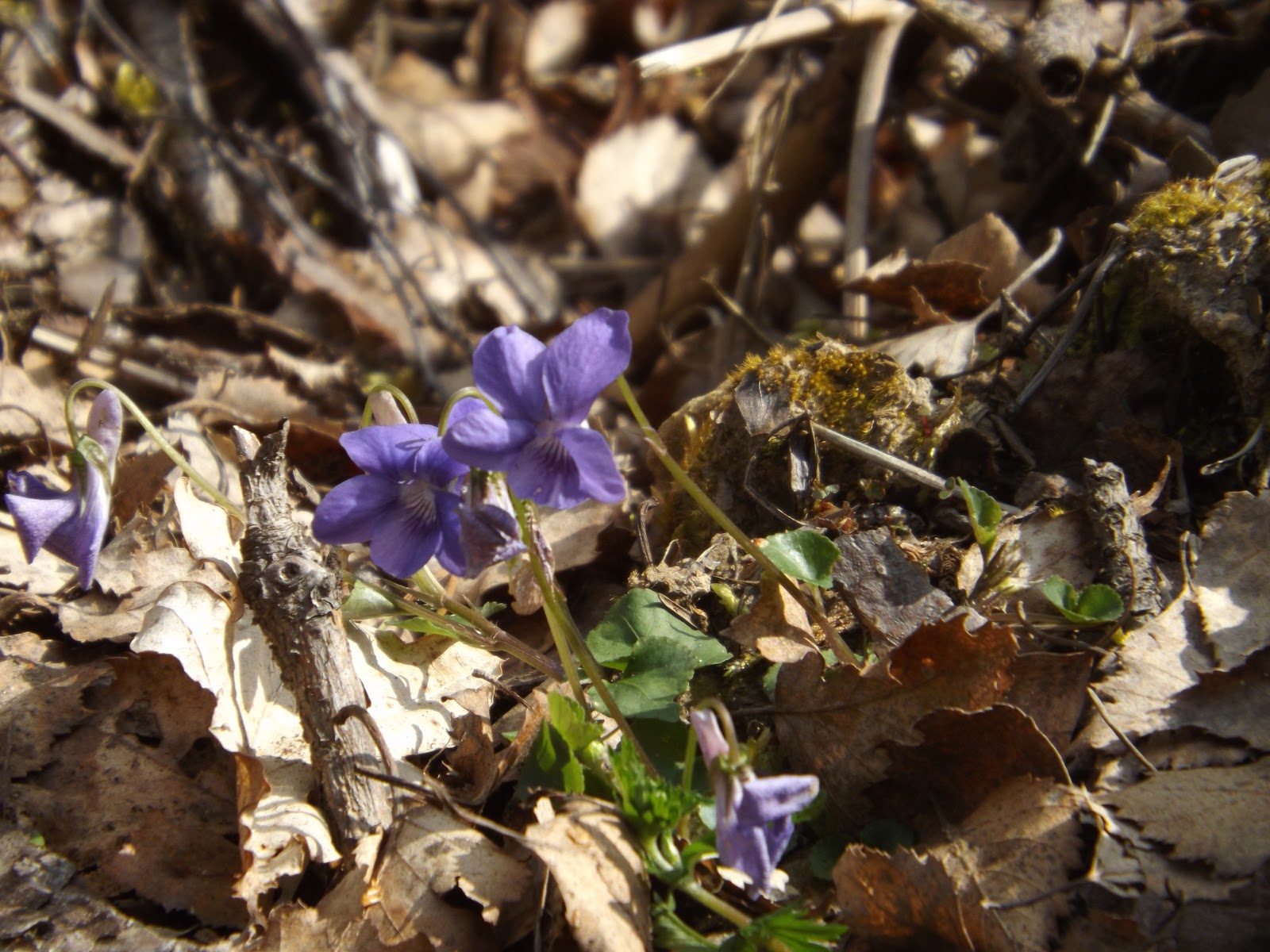
We wrote about our spreading patches of wild daffodils in a previous post. Here are some more examples of regenerating ground flora:

Violets 

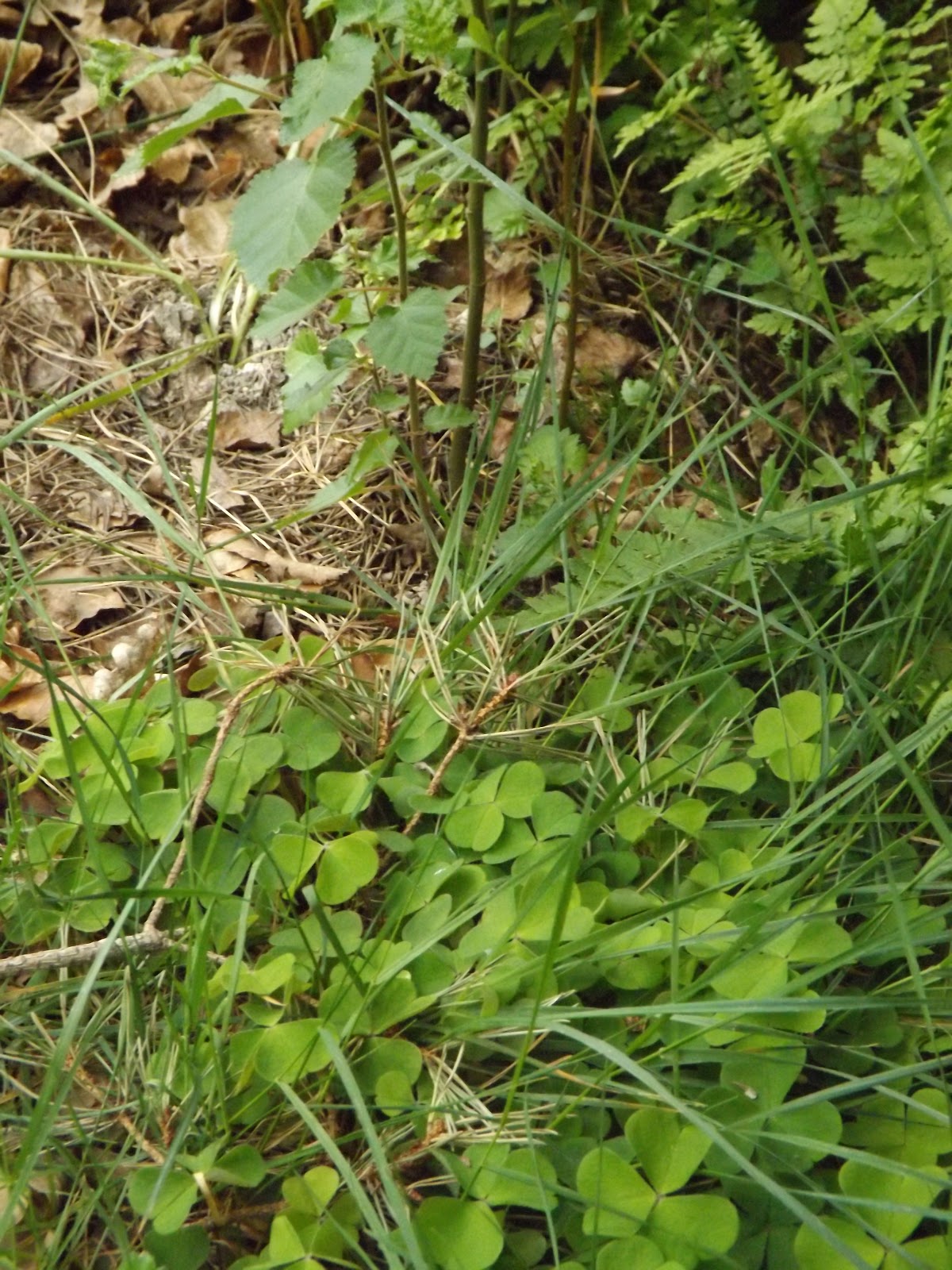
Just outside the cabin - ferns, wood sorrel, birch, grasses

New lush grass in a damp spot 

Rowan emerges in abundance and is usually eaten by deer, but we protect some we want to keep. We'll need to fit a longer tube on the rowan in the photo below .


A new patch of heather

Woodsage


Willow springing up next to the deck

We're getting much better at growing our own trees . Last December we came across abundant acorns at Wakehurst Place (National Trust/Kew Gardens), 13 miles from Old Copse. They looked especially large and robust, so we gathered a couple of handfuls and plonked them into small pots of compost , not really expecting much of a result. So we were very pleased to see them all successfully germinating and growing into sturdy young oak trees. We should have more than 40 to plant out next Autumn.


It has been an exceptionally dry Spring so far and we have been worrying about the survival of the 500 + tree 'whips' we planted last Autumn. But  under the dry pine needle and deciduous leaf  'crust', the soil is still damp. We would like a really good downpour though to get the trees through their first season. Both the willow grove and the alder wood are looking good, inhabited by marsh tits attracted by their dampness.


Willow pollards with shoots removed last winter. We pollard by rotation, a section at a time, so there's a variety of growth..

We came across a fallow deer corpse in the willow grove. We think it might have been injured on the road and made its way into the willow grove to die. Herbie was very interested, but also nervous about approaching it. After a bit he decided that the corpse wasn't a threat and  got closer to have a sniff. It was quite fresh - the buzzards, crows , foxes and badgers will make short work of it.


Tuesday, 14 July 2015

Bracken overload

At this time of year, the bracken is growing to a monstrous size, in some places becoming impassable without a struggle, making  parts of the wood no go areas. There seems to be much more of it in OC1 (South 15 acres)   where it is most insistent in the few small areas that  have been clear felled of birch and/or Scots Pine. This  has allowed the sun in, and the bracken to completely  take over from early June to late September.

During the winter of  20011 a new glade was created in the Scots Pine adjacent to the Pond.The spot was chosen because the pine was quite sparse , so not much felling was involved. Unfortunately, once  the pines were removed, the bracken immediately rushed in, growing taller each year until now it is impossible to get through. 


The felled pine trees in the new glade, cut to lengths


The resulting sea of bracken


A path, bracken bashed from the clearing to the cabin . Recently I disturbed a large grass snake while it  basked in the sun on the path, and watched as it  slithered away into the bracken.

There doesn't seem to be so much bracken in OC2 (North 15 acres) and this seems to be not always connected to light and shade levels, for example, the 'deer scallop' , the open area which joins up with a new track leading off from the car park, is very sunny , and covered with bluebells in May, followed by soft grasses and ferns in the summer, but there is very little bracken.We don't know why this is so. I suppose we have to live with bracken that takes over during the summer before it dies back in September, as long as the paths, tracks, Rides,  and other areas of high use such as around the Cabin, are kept clear - regular walking about and driving  in these places will keep it down anyway. There is not much bracken in the wetter areas of the wood.

Bracken  deprives other species of light, makes a deep litter of dead rust brown leaves in the Autumn and  produces chemicals that inhibit seed germination and seedling growth , thus  preventing regeneration.  Bluebells seem most able to survive it, primarily because they emerge before the bracken gets going,  though we've seen  increased bluebell cover where the bracken has been removed so it doesn't smother the bluebell bulbs in heaps of dead leaves.. Mosses seem able to flourish underneath it, but very little else. Historically, bracken was harvested for a number of uses, but since this ceased it has spread unchecked, particularly in dry acid soil, of which much of Old Copse is composed.  It spreads by underground rhizomes or on bare ground by spores.

Sarah, bracken bashing in the 'car park clearing', made in 2010
There are a few suggestions for
bracken control.  Treating with herbicide ,  except we don't want to use herbicides in the wood. Regular rolling - with what, we''re not clear;  and other manual methods such as frequent pulling, breaking, and top whipping  all of which can be done quite easily, it's not hard work, and children enjoy  it , especially if a small bribe is on offer - the problem is that it's time consuming. Some people advise getting a few pigs in -  but as well as rooting out the bracken and brambles (good), they'll eat the bluebell bulbs (not good).                                                                                                                                                            
 The first small clearing we made in the birch in 2010  was developing a nice line in foxgloves and   bluebells primarily because of our strict bracken control. However, recent monitoring indicates  reduced flowering . This would appear to be because control has been neglected in the clearing because the two of us simply do not have the time to do it as regularly as it needs. But it might also be because of the increased amount of grass which is growing taller each year and might add to the struggle that some ground flora will have.

It's not all bad news though. Bracken supports 40 species of invertebrates, and for 27 of these it forms an important part of their diet. 11 are found only on bracken. It is used as cover by birds , and shelters reptiles and mammals. But, like another 'thug'  - bramble, which  in moderation, also has its uses to wildlife, we don't want it at the expense of almost everything else. Biodiversity is proving harder to encourage than we originally thought.

 We plan to start some end of Summer mowing/strimming to see what difference this makes. This might help keep down the fast emerging brambles, which along with bracken gives us a double headache. Also, having learned from the clear felling episodes in OC1, we will pay close attention to light levels in any future felling project , and aim to keep a careful balance between light and shade,. Once the Scots Pine thin is completed, we'll do some replanting with broad leaves which, as they grow, will help to discourage rampant bracken growth .

Where the tractor and digger compressed and  turned over the ground during the cabin build last year, the bracken is making determined efforts to return to full strength, but it is easier to control around the cabin.. It's interesting to see what is coming up  in its stead. We haven't so far  identified all of the plants, and are hoping that the deer don't make a meal of  the new growth.


Monday, 8 September 2014

Visiting another wood

Such an enjoyable and interesting  visit to Sylvia and Steve's wood, 4 1/2 miles south west of  Old Copse.  The wood , on flat land,  is  part of a narrow 'shaw' surrounded by fields. It is designated ancient woodland, and the structure of it is perfect,  with  many mature trees, a canopy of mainly ash ( no sign of ash die back disease)  with  beech, oak and birch,  -  a mature  hawthorn and even  a wild service tree.  The understory has much hazel,  some crab apple and  bird cherry. The floor is smothered in dog's mercury,  and sedge which they are controlling in the wet and compacted areas. As for woodland 'thugs', there are a few small patches of bramble, and a bit of bracken around the edges - lucky people.  This structure is exactly what we're aiming for at  Old Copse.


The farmer who sold them the land had previously used the wooded section for an  off road 4 x 4  business which caused extensive  damage to the ground. But it is now slowly healing, and at this time of the year the scars are difficult to see. In time, though many of the worst compacted ruts will remain, they will soften and eventually blend in. It's good that Sylvia and Steve have stepped in to look after this lovely piece of woodland.

There is not much evidence of deer, though they are certainly around. Their deer stalker seems to have done a great job in reducing their numbers .  In addition to the woodland there is an adjoining  2 acre field. 3 years ago they planted up most of it,  leaving an open area in the middle, with a mixture of native broadleaves, and a variety of fruit and nut trees. These have suffered periodic deer attacks, but the majority have survived and many of them  are now just about above deer munching height. They made simple (and relatively cheap) deer protectors of stakes and fencing wire (bought by the roll from Horsham Fencing).The deer have tried, with some success, to push these down, but overall this protection has been adequate.


One of our management plan targets is to clear fell 1/2 hectare in the OC2 birch and replant with native broadleaves.  Old Copse topography is different to Sylvia and Steve's, though the underlying soil is more or less the same. One of the difficulties in doing something similar to them is that Old Copse is on a slope and the top soil is probably a great deal thinner and less fertile than their flat open field. Next time we visit we will check the depth and take a soil sample. Sylvia explained that most of their trees were supplied by Ashridge nurseries, which we will investigate.

Other useful tips  included their lighting system, which consists of LED bulbs connected to a battery. They use a 15W solar panel to recharge the battery. This is not permanently mounted, but moved in and out as required and to catch the sun. They also have an inverter to run laptops. Suppliers include LED Hut (online)and Maplins. They suggested that we try a strimmer for bracken control. This is another good idea, and we may try hiring one for a day to see how effective one is before we take the step of buying one.