Another year gone, but we've achieved a lot:

A beautiful, much loved and much used log-cabin shelter has been built; a new entrance track , and parking place has been constructed; ride-side widening is completed, and the resulting timber has been cut and organised properly.
Working with others and building up contacts
We have a few regular cord-buying customers, who live locally, we also burn a lot of wood ourselves in various wood burners and open fires, and plenty is left to rot down on the ground.
We have begun an informal bartering system too, exchanging skilled labour for firewood. This is something we want to develop more in future - working with like-minded woodspeople who support our objectives , and who can offer Old Copse something in exchange for what Old Copse can offer them, without money changing hands.
Holly in the SSSI, Work in the birch
There's far too much holly so we've started a major thin . We want to finish this job during the next 6 months, At the same time we'll do more work in the birch side of the wood creating a meandering ride running roughly South to North, 'halo' thinning round the many young broadleaves that are at present hemmed in by birch, while also creating additional glades and paths. The final job in the birch will be by way of an experiment, to clear fell an acre or so, replanting with native broadleaves, and perhaps some nut trees and fruit trees if the soil will support them. Strong deer protection will be needed for this project, unless the deer stalker has been exceptionally successful.
Progress in the Pine plantation
 |
| Milo gets some felling practice in the Scots Pine |
We'll continue thinning Scot's Pine with a chainsaw in the coming months, and also perhaps try out a small harvester, but next Autumn it looks likely that a 30% fell could take place.We had more or less given up on this idea, having done a lot of research, and vacillated first one way then another , but at last we might have found a contractor who will do the job sensitively, at no cost, and moreover pay us for the extracted timber. So fingers crossed, by early 2016 we'll have solved the Scot's Pine plantation problem.
Next? well, there will always
be work to do , and improvements to make; that's the nature of woodland management. But by mid 2018 , which will mark the end of our first 5 year plan for Old Copse 2, the aim is that the initial major work of restoration will be completed and Old Copse will be well on its way to light, health, and increased bio-diversity.
Below is a letter (paraphrased) from Natural England
Old Copse is a Site of Special Scientific Interest (SSSI) and an Ancient Semi-Natural Woodland (ASNW), part of which is Plantation on an Ancient Woodland Site (PAWS) . An ASNW is an area of woodland that has been continuously wooded since at least the 1600's; this is a good indication that the site has never been completely cleared of trees and as such has been woodland for thousands of years. These woodlands tend to be rich in diversity and the continued existence of such habitat is vital for the survival of many woodland species. Such sites now only occupy 1% of land area in the UK and concern about the continued loss of ASNW's has prompted the drive to maintain these woodlands in a healthy state and return PAWS areas back to native broadleaved woodlands. The area was found to be in unfavourable condition when I carried out an integrated Site Assessment on May 12th 2012. The reasons for this were:
- Lack of open space and closure of rides.
- Ground flora lost to heavy shading in large parts of the site.
- Very little regeneration of young trees and saplings.
- Understory dominated by holly, no hazel or other shrubs.
 |
| A few more pines to fell to create a new view |
In a relatively short time I think it not unreasonable to hope our work has improved the status of Old Copse (or at least, our 30 acres of it) from unf
avourable' to
'recovering' . From there to '
favourable' will take a little longer than our first 5 year plan, but we'll be doing all we can to reach that point.


 The Purple Emperor is the second largest butterfly in Britain ... only the Swallowtail being larger. It is rarely seen unless a special effort is made to find it as it flies high in the tree-tops of woodland where it feeds on aphid honeydew and sap runs. Its range is now restricted to some of the larger woods in southern England. There are colonies in Southwater Woods (eight miles to the west) and at Knepp Castle Estate (nine miles to the southwest), so it's not unreasonable to hope that it could one day return to Old Copse if the conditions are right.


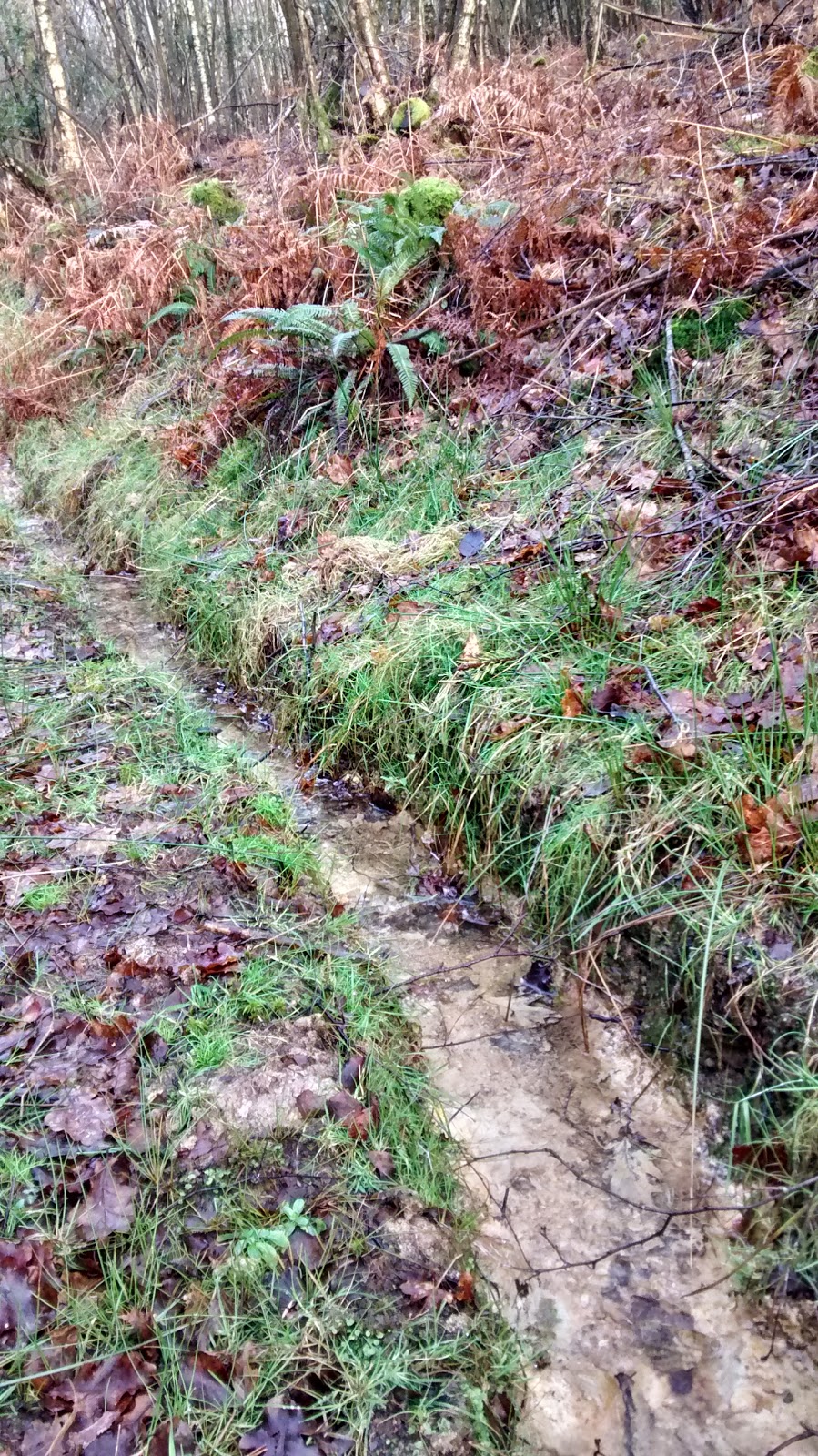


 While trying to decide where to thin some Scots Pine on the north-west side of OC2 we saw that we would first have to remove a great deal of dense dark holly in order to see what we were doing.


