Recently we put up three deer monitoring enclosures in different areas of the wood. The purpose of these is to observe what grows on the ground when the deer are kept out. They'll stay in place for a at least 2 years. Although we suspect, and there certainly seems to be evidence, that the deer eat almost everything that tries to regenerate, we don't know for sure how the wood might be without their depredations. But we should get an idea of the difference it would make with far fewer deer.
Tuesday, 19 May 2015
Deer Monitoring
Recently we put up three deer monitoring enclosures in different areas of the wood. The purpose of these is to observe what grows on the ground when the deer are kept out. They'll stay in place for a at least 2 years. Although we suspect, and there certainly seems to be evidence, that the deer eat almost everything that tries to regenerate, we don't know for sure how the wood might be without their depredations. But we should get an idea of the difference it would make with far fewer deer.
Monday, 18 May 2015
Encounter with an Owl and a few other birds
![]() |
| Owl in a beech tree (library picture) |
On the afternoon after Milo's party I was strolling around in the birch at the top (North) end of the wood when I saw a dark shape three quarters of the way up a tall beech tree. Creeping closer, the shape swiveled its head and resolved itself into a tawny owl. We hear them hooting a lot but clear sightings are much rarer. He looked at me with his large black eyes and I stared back. We stared at each other for a full two minutes before he swooped off on a hunting expedition. Presumably he was starting out early because the night before had been too wet for hunting. Either that or his prey had been put off by the techno coming from the yurt. Naturally I did not have a camera, but the above library picture gives something of the feel of the encounter.
It's not easy, this wild-life photography. Only a few birds move slowly enough to have their picture taken. Sue took this one of a pheasant strolling nonchalantly through the wood.
A fisherman told us he's been trying for ages to get a good picture of a kingfisher zipping by on its regular pond side beat. Although it passes every hour at the same height it's always just out of shot.
Also seen and heard: A cuckoo was heard for the first time today, calling from just across the Hawkins Pond . It's rather late this year, as it is usually heard in April. Two moorhens were seen with their young broods on the pond, and two Greater spotted woodpeckers in the Scots Pine.
Thursday, 7 May 2015
Encouraging Dormice
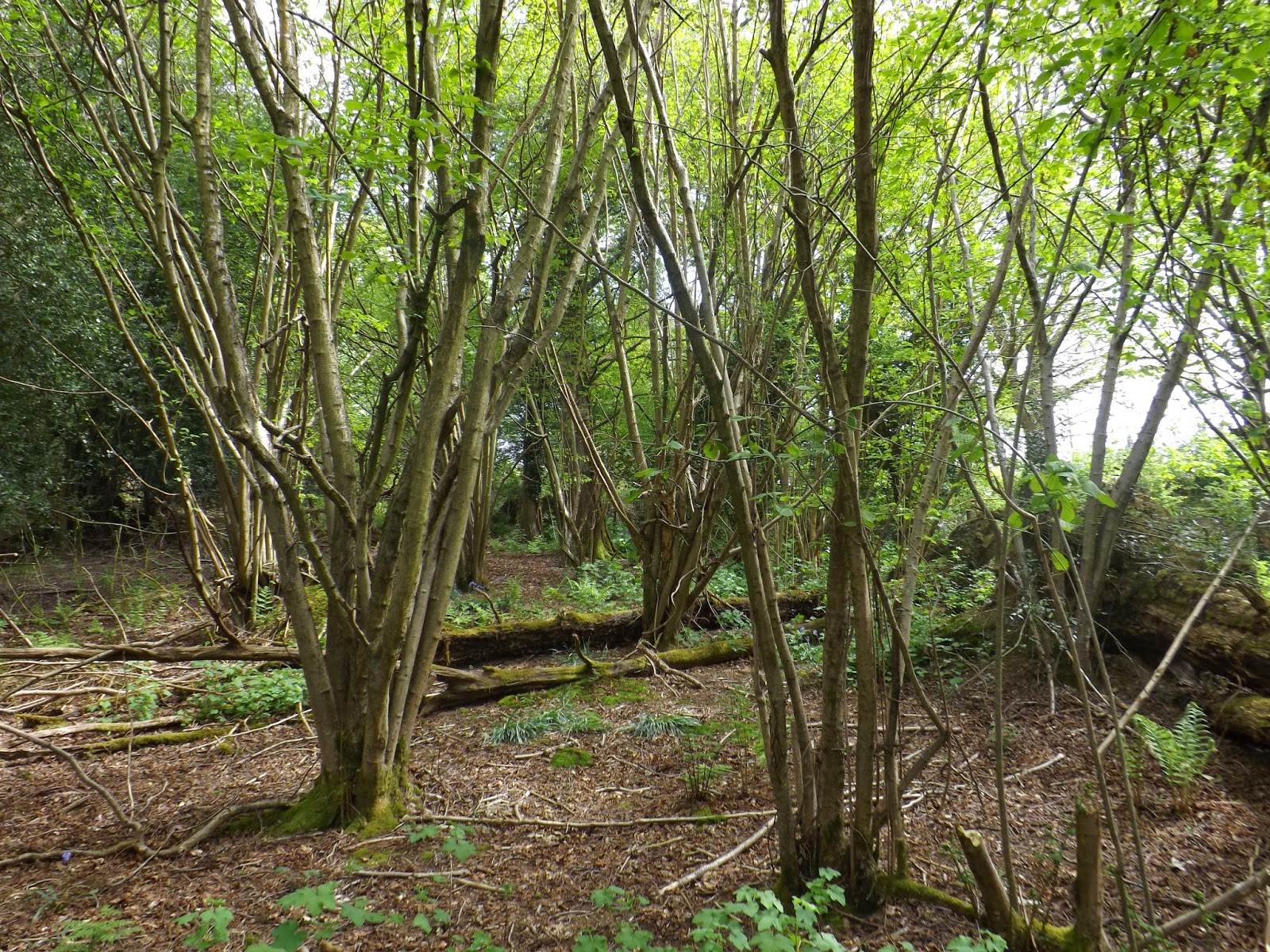
| Badly neglected hazel coppice. Another important job to tackle. |
However, surveys have shown that dormice are more adaptable than previously thought, and have been found nesting in a wide variety of habitats, even in gardens and conifer plantations. So we hope to be lucky and find evidence of these charming, but rare and elusive little creatures. The nesting tubes are of a very simple construction, so we'll be making some more to provide as many convenient homes as possible for any stray dormice.The tubes must be checked every month or so for evidence of use. If there is food in the tube then it is likely to be a wood mouse rather than a dormouse. Ditto, dead leaves - dormice only use fresh green leaves in their nests. As for droppings, we're not at all sure if we could tell what sort of mouse they belong to. So, it's not going to be easy to find firm evidence of their presence in Old Copse.
| Dormouse nest tube (library picture) |
| Dormouse nest (library picture) |
Sunday, 3 May 2015
Thursday, 30 April 2015
Sunday, 26 April 2015
On the cusp
|
| The only Hornbeam in the wood and on its left, the only Aspen |
We had a chat with a fisherman on the Pond who said he saw a huge group of deer last week on the opposite side of the water. He heard the noise of their hooves before he spotted them. He managed to count 46 including 5 or 6 white ones, which are a sign of overpopulation and inbreeding. The deer stalking season is now over and soon this year's young will be born, enlarging numbers even further. The deer stalker only managed to bag four this season, so we're not even keeping up with their reproduction rates. Clearly we'll need to do something more, though not sure what. Introduce a couple of lynx or a wolf perhaps......................


| The willows pollarded this year are just starting to shoot. |
Sunday, 19 April 2015
Work continues
4 months ago we started clearing the holly on the SSSI side of the wood, and the optimistic aim was to finish the job in 6 months. While we don't think we'll quite meet that target the work is making a real difference, letting in light to the woodland floor and revealing surprisingly diverse and beautiful parts of the wood previously hidden by dense dark holly growth. We're working in the north of the wood adjacent to the end of the pond which floods in the winter and dries to a small stream and boggy area from Spring to Autumn. Before we started we could just glimpse through the holly 5 or 6 large oaks bracketed by two huge Scots Pines, all of which must have been planted well over a hundred years ago. In addition there is a large number of small beech which have been protected from the deer by the holly - so it does have its uses. The holly in this area had grown 30-40ft high, closing the canopy leaving only naked holly stems reaching up through the dense shade. The cleared area is becoming transformed; the oaks and Scots Pines can now be seen properly, the sun can get in, and patches of sky can now be seen. When it's all done we'll make a holly trunk seat to encourage the sitting and enjoying of a tranquil, atmospheric spot.
Another current project is the cutting of a track/bluebell walk running from South to North, starting just North of the birch clearing adjacent to the new entrance and car park. The track will allow in light from the South, and meander through the birch wood passing oaks, rowan and beech, joining the Ride via the 'deer scallop' created a couple of years ago by the deer stalkers. Once the track is done, the birch on either side will be pollarded, and finally, hazel, propagated from the wood, will be planted in front of the pollarded birch to create a graded woodland edge.
![]() |
| There are a few patches of bluebells , increased light will soon encourage them to spread. |
Subscribe to:
Posts (Atom)