Sunday, 10 March 2019

Mild winter, early Spring

Looking back over previous posts it seems I write about the appearance of the wild daffodils every year. That's because they are such an obvious sign of the coming Spring. This year they are earlier than ever. The first ones and twos were in bloom on 3rd March, with lots of flowers a week later. In 2016 and 2017 the daffodils weren't in bloom until the third week of March. That's a full two weeks early this year!

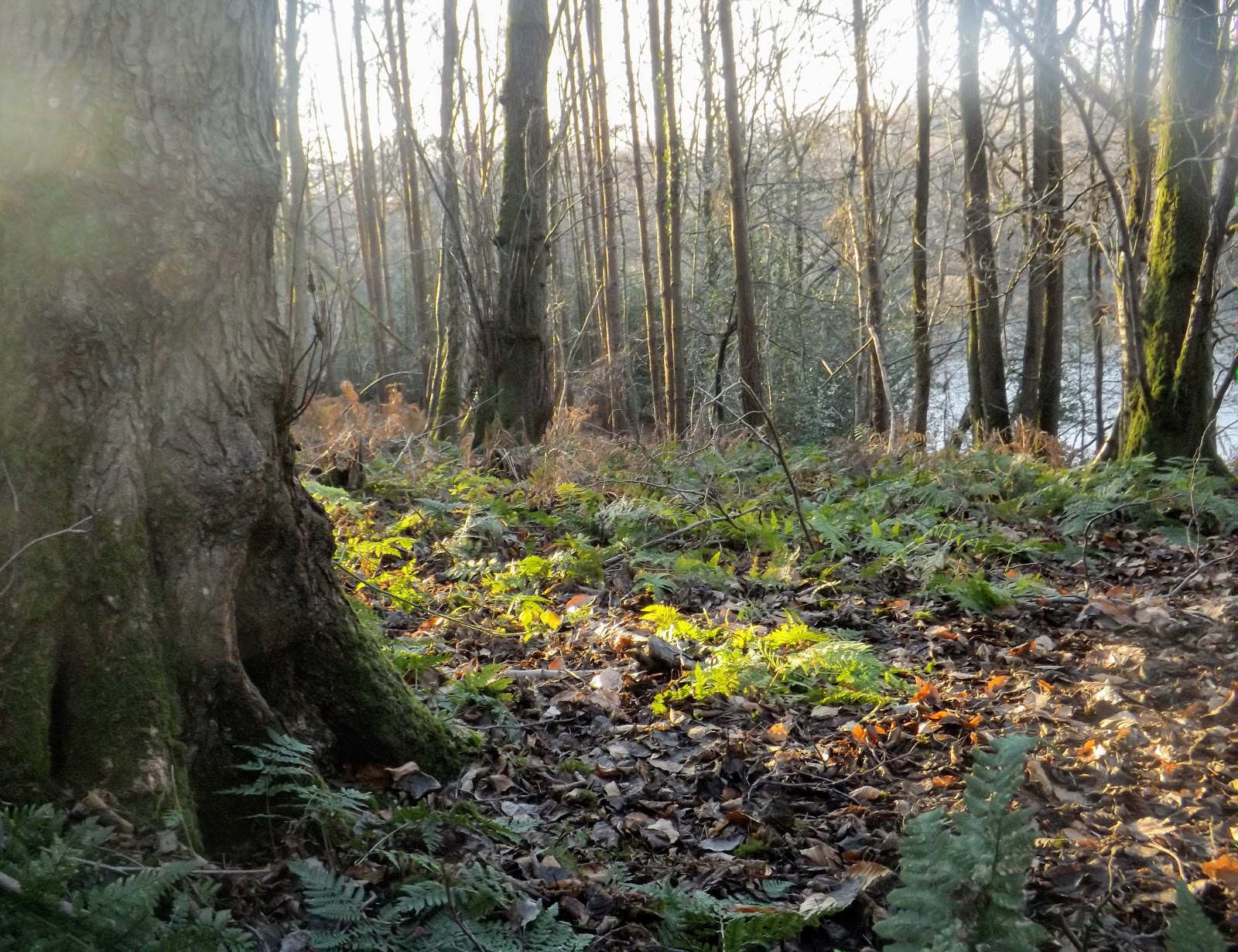
Winter was very mild, with only one small scattering of snow and maybe one frost. The result is that the wood does not have the 'flattened' look is usually has at this time of the year. The dead bracken has not been broken down by frost and crushed by snow. As a result the ground layer still has a high covering of dead material, when it's usually bare in early Spring. While offering protection for small mammals, this may mean that other regeneration will struggle for light this year as it will have to fight through this lot - see photo below.


All of this has been making us think about planting for climate change, and trying to decide how best to approach it. There is one school of thought which says that our native trees will adapt, and they will self select; the trees best genetically suited will survive. Other people suggest planting species which come from further south.  We're not planting for timber  - we want to restore our bit of ancient woodland and associated ground flora, so we're wary of introducing non native species, due to the potential effect it might have on the vegetation community.  So one route might be to plant tree types that exist in our woodland community - oaks, beech, rowan, birch, crabapple - but which have non native provenance. So we could look for trees of the same species which are generally grown further south - say in western France.

The danger is of course is that climate change is not just making our weather warmer, but more uncertain. So more southern trees would still have to be able to survive occasional but severe late frosts  - such as the one which killed off a  pot grown walnut we planted the winter before last  This technical paper suggests that planting a mixture of species will act as as an insurance. Which seems like common sense.

I suspect we'll take the cautious route: planting more native broadleaves to make the wood more diverse and trying out a few with non native provenance to see how they get on.


Monday, 21 January 2019

Busy January, working and looking.

A beautiful day. Cold but gloriously sunny. We started the day with  more  hedge planting along the roadside,  a project we began last winter.  The idea is to do a bit more each year until there is a substantial  barrier between the wood and the road, and then, when it has grown tall and thick enough, start laying it in the traditional way. It's all experimentation so we'll see how it goes. The hedging plants have done better at the northern end , not so well  at the south. Not sure why, perhaps because it's  shadier down there, and the ground is definitely worse, almost all sandstone and clay.


It's easier and faster to do this time around because we're not using rabbit spirals as there don't seem to be any rabbits, or bamboo canes as these don't seem to have much of a purpose. The plants appear to be doing fine without them. Plus, we're becoming tree and hedge planting experts!


There is quite a lot of  badly neglected hazel at the southern boundary . Originally planted for coppicing, it hasn't been touched for many years , and  branches have grown long, thin and tangled , bending in all directions, and over 30 feet in height.  Cutting will improve its health and strength. 

  
                                            Hazel before it is coppiced or pollarded


While ideally we would coppice them it's going to be almost impossible because the deer will eat all the emerging new shoots however much we try and protect them.  So, we'll  pollard the stems, i.e.  cut them at above deer munching height . At least this will add a different  height layer to the wood. The  Willow Grove which we started working on a few years ago, has been very successful in creating a much needed shrub layer for the wood. That project is ongoing , we are still felling birch there, and  will have to cut the pollard stems soon, but we are pleased with the results of our work. Luckily, hazel is much easier to cut than hard springy willow, so it shouldn't take us too long to get the job done.
.
Pollarded hazel, surrounded by the cut tops, to keep the deer from eating the new Spring shoots
.
                                            Part of the pollarded Willow Grove in winter.


At this time of the year. the wide paths made by the machinery during the Scots Pine plantation thin in late 2015 are very noticeable. After the work was done, these paths were just churned mud, but now they are grassy small glades , with a much more diverse ground flora. This is because the tractor flattened the bracken and seems to have destroyed its rhizomatic  roots - the welcome result being that it hasn't returned!  a real bonus. It might even be worth doing a bit more thinning in the Scots Pine area just to get rid of more bracken. Bracken is a problem for us, and there is a great deal of information on this: e,g, as  Professor Rob Marrs from Liverpool University says:

'Brambles, bracken and ivy are threatening the future of Britain's woodland, new research has concluded. ... Biologists fear the plants are a major threat to biodiversity in Britain's wooded areas and are potentially more damaging than invasive species that have been introduced to the countryside from abroad'.

New  glades thanks to tractor bashing.


A stroll through the 'wet wood'  , though not as wet as it should be this dry winter,  on the way to the (soon to be )  Hazel Grove


Full moon tonight, reflected in the Hammer Pond. 

Friday, 11 January 2019

Planting continues

A murky January day getting on with planting. We've begun this annual winter task a bit late , normally trying to get it done before Christmas. There won't be as much to do this year. Only planning to plant  about 200  this season.  We started with creating a small Hazel Grove  in an area of the wood colonised by birch , choosing a spot with a lot of bramble in it, which clearly gets more sun than other areas .  The hazel should do well here, with the added bonus of it eventually shading out the bramble . It's all about the light levels  - too much light  and an area is taken over by bracken and bramble, too little, and nothing much will grow.   We are always conscious of trying to strike the best balance. We are using recycled tree tubes, and the stakes are  poles from another area of the wood where there is a lot of neglected hazel. We will pollard  this before the Spring to improve its health and strength and harvest their very useful, strong and straight  poles at the same time.   We might also try a bit of experimental coppicing, but are a bit wary of doing this because of the somewhat diminishing, but still present  chance of deer depredation. They love fresh green hazel shoots!

The hazel poles have the bonus of often producing roots, which will  double the number of  plants


A patch of bramble which will very quickly increase in size if left another season.We have plenty of the stuff for wildlife, but un-managed it will very soon take over  a large area 


The soil here was pretty good for planting - not too much sandstone.

Sunday, 30 December 2018

Holiday get together

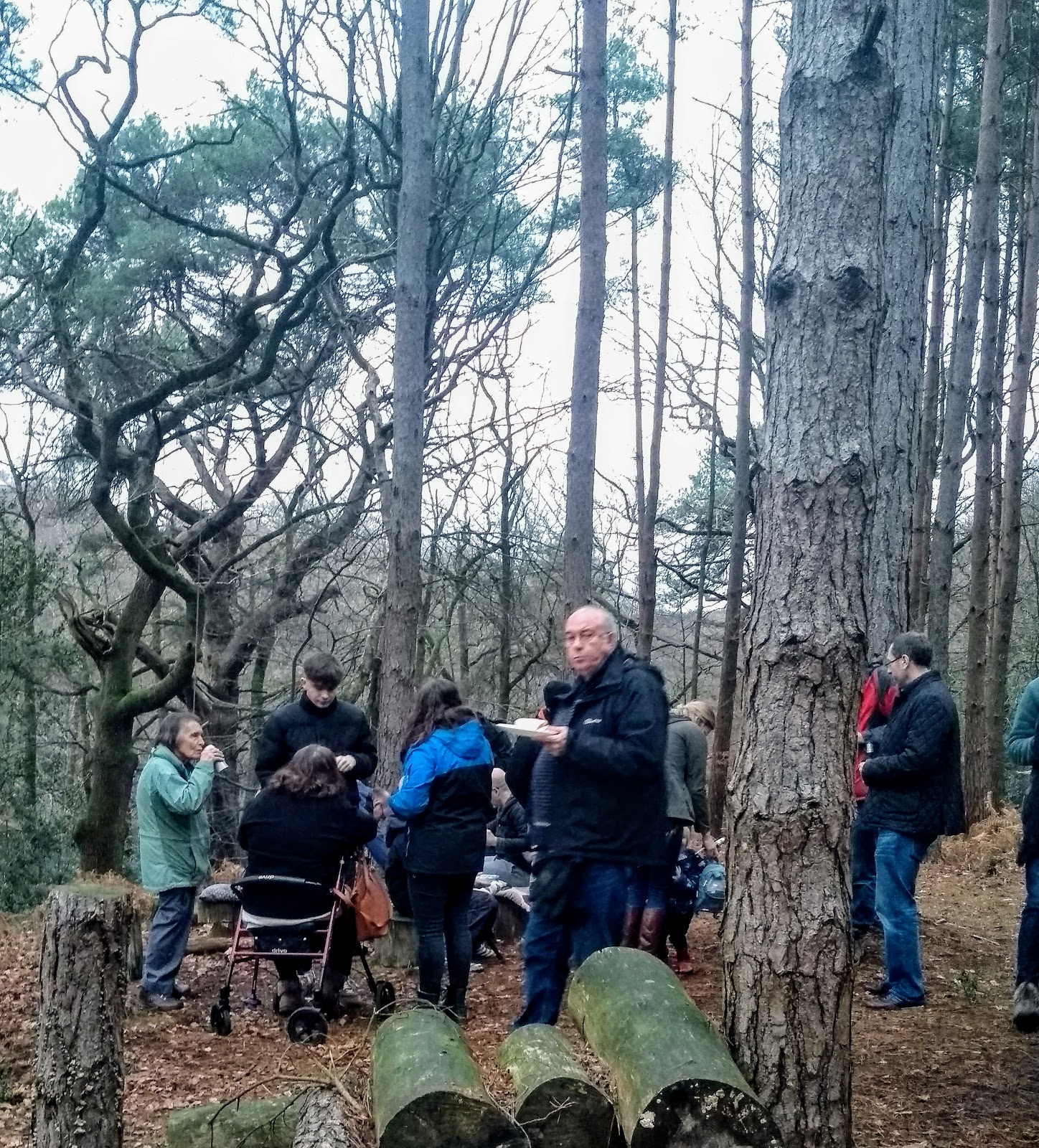
Despite post Christmas flu, midwinter gloom and other assorted reasons for staying close to home, a stalwart  group made it to Old Copse on December 30th. It was unseasonably mild , there was an abundance of food and drink, and a modest but highly appreciated firework display , provided by  Sarah, Simon and Stanley. Plus just being in Old Copse , lovely even at this bleak time of year.


Demonstration of the ancient table mat flapping technique for getting the charcoal going.


Jane


and Jane's Grand-daughter Mabel


Mabel and Isla size each other up. 


Father and daughter


Father and son . Full marks for getting the bonfire started. No wonder they looked pleased.


                                  All Best Wishes for a Happy New Year to Everyone.

What a difference a saw makes


Mark  made a pre-Christmas visit to the wood to present us with our favourite tipples and a quantity of Old Copse venison, which we were very happy to receive. In addition there was a mysterious large heavy box wrapped in Christmas paper which he handed over with strict instructions not to open it before Christmas.

 So, much surprise and happiness  when the parcel was unwrapped on Christmas day. Thanks to a very generous Christmas present from Mark and all the other members of DAGS (deer stalking group), we are now proud owners of an electric chainsaw!

What a difference! It starts just by pushing a button, so no wrestling with pull cords. No nasty petrol,   quiet, only weighs 4 kilos,  it chopped up  firewood beautifully and no doubt will do the same when felling trees.  The battery seems to last as long as my desire to use it.

Thanks chaps! Best ever Christmas present.


Sunday, 23 December 2018

Boys in the Wood

 
A Grandson celebrates his winter solstice birthday in the wood with some friends. Inner city London boys, they left the big city behind to come down to the wild, wild wood for a stay in the cabin.  I think they had a very good time. Off to different Universities in the next couple of years  it was a chance to spend some time  together before going back to more exam  swotting. It's good to see a younger generation enjoying the wood , even in winter, with darkness falling at  3.30 p.m


Photos by Angelo, Dylan, Ibrahim, and Oliver


                                     Difficult to get the fire going when it's been so rainy


Still life with electric toothbrush


Thursday, 29 November 2018

Piles, heaps and twigs

As the leaves fall,  bracken dries and droops  and the wood grows gradually barer and barer, the heaps reappear on the woodland floor. Every time we fell a tree, the trunks are trimmed and stacked for firewood, but for every set of neatly cut trunks there still remains a great mass of brash - that is thin branches, leaves and twigs. This stuff is endlessly useful as additional deer protection for small saplings, as anti squirrel devices, But there is always more than we can use, which ends up being left in piles around the wood. It takes a surprisingly long time to decay, and while it is hidden by the bracken during the summer, at this time of the year the piles and heaps reemerge.

Some heaps show obvious signs of being used as shelters. We see indentations where creatures have pushed their way in, maybe to hide from a passing predator overhead. Sometimes there are bigger tunnels which lead into the middle of the heap. Wrens are particularly fond of a good heap of twiggy sticks, and are often found hunting for insects.

The mundane twig hardly ever gets a mention on this blog. We talk a lot about the trees, flowers, fungi and wildlife, but twigs hardly figure. Maybe we just take them for granted, as they are such an ordinary part of the landscape. Yet by sheer volume, twigs - whether growing or drying in heaps - form a huge part of the woodland biomass. And they're just as useful to us as they are to creatures.  Dry birch twigs are still the best kindling. One regular job is to collect a big bag every week to light the home fire with.

In former times twigs were much more valued as a woodland product. Now they're rather overlooked. The papers had a good scoff at this online retailer selling a bundle of decorative twigs for £40. They claim they sold out, but I suspect that's just a story to save face. More interesting was this picture I found on the SWOG Facebook page of brash being bundled up for sale to create temporary hurdles. It could have been taken 100 years ago. Looks like birch twigs to me.

Thanks to Tim Davis for photo