Friday, 26 July 2019

Bats at Old Copse

The bats are a key part of life at Old Copse. One of the wood's great pleasures is to sit by the water's edge at the end of the day and wait for them to emerge as the light fades. They come whizzing out of the trees, zipping over our heads and swooping out over the pond. Although the fishermen told us these were Daubenton bats, we never knew if that was right or what other species were also there. So we were really pleased when Kevin Erwill of the Gatwick Greenspace Partnership and Martyn Cooke of the Surrey Bat Group agreed to come and spend a Sunday evening at Old Copse to help identify our bats.

Martyn arrived with some impressive kit; a large antenna sprouted from a backpack which turned out to hold a very sophisticated bat detector.

Bat detectorists

Down at a swim at the edge of the pond, after a bit of a wait the first bats came out - Soprano pipistrelles (Pipistrellus pygmaeus) and common pipistrelles (Pipistrellus pipistrellus). According to the Sussex Bat group both of these are widespread and fairly common in Sussex. Then as it got darker the Daubentons bats (Myotis daubentonii) came out to hunt across the pond. It was a real thrill to watch them through Martyn's infra red binoculars, which picked up not only the bats but their reflections as they flew over the water. It was a genuine privilege to watch and listen to something that's usually hidden in the dark.

This bit of film of Daubenton's from the Bat Conservation Trust (although not via infra red) gives an idea of what we saw.


By then it was almost pitch dark and we tried our luck in a different habitat, in the big clearing in OC1. Martyn's kit clearly picked up four more species:

  • Serotine - (Eptesicus serotinus) - uncommon, widespread in Sussex
  • Natterer (Myotis nattereri) - scarce, widespread in Sussex
  • Brown Long-eared (Plecotus auritus) - relatively abundant, widespread in Sussex


And even what he was certain was a Bechstein's (Myotis bechsteinii), a very rare bat indeed. And who are we to argue with an expert?

So that's seven different types of bats identified in a couple of hours. According to Martyn there are 12 species at Gatwick, so it's likely that there are more than seven at Old Copse. Maybe I'll invest in a bat detector...

Thanks to both. It was a great evening. 

Monday, 24 June 2019

Deer cam

The trail cam was up taking photos and video on the ride in OC1 from 9th -20th June. We were hoping for all sorts of wildlife, but what we got was - deer.

Mostly the camera caught individuals, usually appearing between eight and ten o'clock in the evening. It was good to have confirmed that the deer management is having an affect on numbers. Heading south to north, they often stopped to feed on the holly hanging over the ride.

This chap was an exception - he appeared at 07.51 in the morning

The fallow have had their babies in the forest and are now coming back to Old Copse. This mummy and baby came through on a Tuesday afternoon just after four pm.


They stayed in the wood until half ten in the evening, when the camera caught them heading back the way they came - this time in the dark.


After 12 sightings 9th-12th June, fallow sightings stopped apart from a couple of individuals several days apart - again at their favourite times of 8-10 in the evening. 

We don't see that many roe deer, so it was good to catch this individual taking advantage of the fallow's temporary absence to have a good run on the ride. 


Friday, 14 June 2019

Growth

This is the time of year to go around the wood looking for seedling trees. They are springing up everywhere, primarily oak, beech, cherry, rowan, alder buckthorn,and  birch. If they're growing in the 'right' place, which is just about anywhere off the Ride, we mark them with a red topped stick and return later to protect them from deer with a small tree tube and stake. Any that pop up on the Ride itself are dug up and planted in the tree seedling enclosure to grow on  and planted back in the wood when they are are a decent size. The birch come up in their hundreds, and dozens have come up around the cabin. Usually the deer eat them  but this year, for the first time we can remember they have hardly touched them. We think it's a combination of them being elsewhere in the Forest at this time of the year, and good deer management.

Oak, cherry and beech seedlings being removed from the ride to grow on


Last year's seedlings are doing well and will be planted out this winter.

This annual job is a really good way to examine what's going on in the wood at ground level. We got really excited when we spotted this empty nest hidden in a mass of dead bracken. Could it be a woodcock's nest? We have seen and heard them in the wood, but this nest seemed a bit big. After a bit of Internet research we concluded it was probably made by the Canada geese. It was beautifully made, but how successfully Canadas rear their young is another question. We're always coming across eggshells in the wood, presumably predated by squirrels and foxes.


The bees are doing well.On June 9th Krzyzstof came to harvest Old Copse honey for the first time. We'll find out how productive they were when we next see him.

The smoker is used to calm the bees while Kriss harvests the honey
Here's a link to Kris's Instagram account with a bit of video of Old Copse bees enjoying the sunshine. 

Wednesday, 22 May 2019

Bluebells

The bluebells were beautiful again this year, such a fleetingly short season, starting towards the end of April and ending by the third week of May here at Old Copse.  I somehow didn't get around to taking the obligatory shot of  a sea of bluebells in among the beech trees, or even a picture of the very first solitary bluebell that had managed to reach  within a few feet of the cabin, sure to be joined by others next Spring , so I'll put a few old ones in.

It feels ridiculously rewarding to witness the results of our work over the past year - the progress of bluebells being  an easy improvement to monitor. I've been watching their onward march  towards the cabin helped by the Scots Pine thinning operation in late 2015, and the strict removal of bracken each year. This is just one example that we're doing the 'right thing' in our approach to the restoration of Old Copse.

 It has become increasingly popular to enjoy the Spring bluebells, whether in private or public woodlands, but it seems there  still exists  carelessness and a lack of  understanding and  respect for this wonderful sight. 


When you see them each year, faithfully pushing through the old leaf  litter in their hundreds,  it may be hard to believe they're a fragile flower. Bluebells don't like change or disturbance, preferring ancient woods where the ground has lain undisturbed for years. Most bluebell woods open to the public have strictly designated paths or raised walkways to stop people trampling them.


Bluebell colonies take a long time to establish - around 5 - 7 years from seed to flower and can take years to recover after footfall damage. If a bluebell's leaves are crushed they die back from lack of food as the leaves cannot photosynthesize. Sadly many people don't know, or choose to ignore this , and also that it is against the law to pick, uproot or destroy bluebells.


So, it was dismaying, to put it mildly,  to discover  recently that not only had unannounced  visitors trampled an area of bluebells which we had been encouraging for several years, but had lit a bonfire on top of the bulbs. This shows a regrettable disrepect for the habitat. Bluebells don't recover very quickly after that sort of treatment.  Of course it isn't always possible to avoid every single bluebell in the wood, and we all sometimes tread on them. But we stop routine woodland springtime work in areas where there are growing colonies of wild daffodils, primroses, and bluebells, and we wouldn't dream of  having parties, picnics, and bonfires in their midst.

                                         Won't be seeing bluebells here again anytime soon


                                                            Plastic party litter by the Pond

This made us think about why anybody would do this. I can only think that they just didn't notice what was growing there, that their observational skills were lacking.  The bracken fairy (i.e. me)  had, over the years  cleared bracken in the  area to encourage ground flora, including bluebells.  The visitors clearly thought it a  nice spot for a party and a bonfire, to take selfies and pose for an Instagram post. However, they failed to really look at their surroundings and notice that while they were enjoying the experience of being away from 6 foot tall bracken, and among the bluebells, they were also crushing and burning them.  I can't imagine this was done deliberately - the site was  tidied,  with only a few bits of litter left to clear up - so it was doubtless just a failure to look and understand. Looking after the wood involves noticing both the general and the details, how over time all the different living elements change, interact and compete. And once you notice these things, you understand better the impact of everything we do - big and small.

Some people might think that the loss of a few bluebells isn't important in the greater scheme of things   .........Oh well, all we can do is continue with the work, protect Old Copse as much as we can,  and maybe in the process,  educate a few people too.


Monday, 20 May 2019

Spring Workparty

 Many hands made light work last Saturday, and a very productive day it was too .............

One of the scheduled projects  was to build an Old Copse woodland growing area in which we plan to experiment with growing fruit and vegetables in three large raised beds protected by deer fencing.  It's located near to the entrance as this is one of the sunniest spots in the wood, and near to the beehives whose occupants we hope will make a good job of pollinating future crops. 


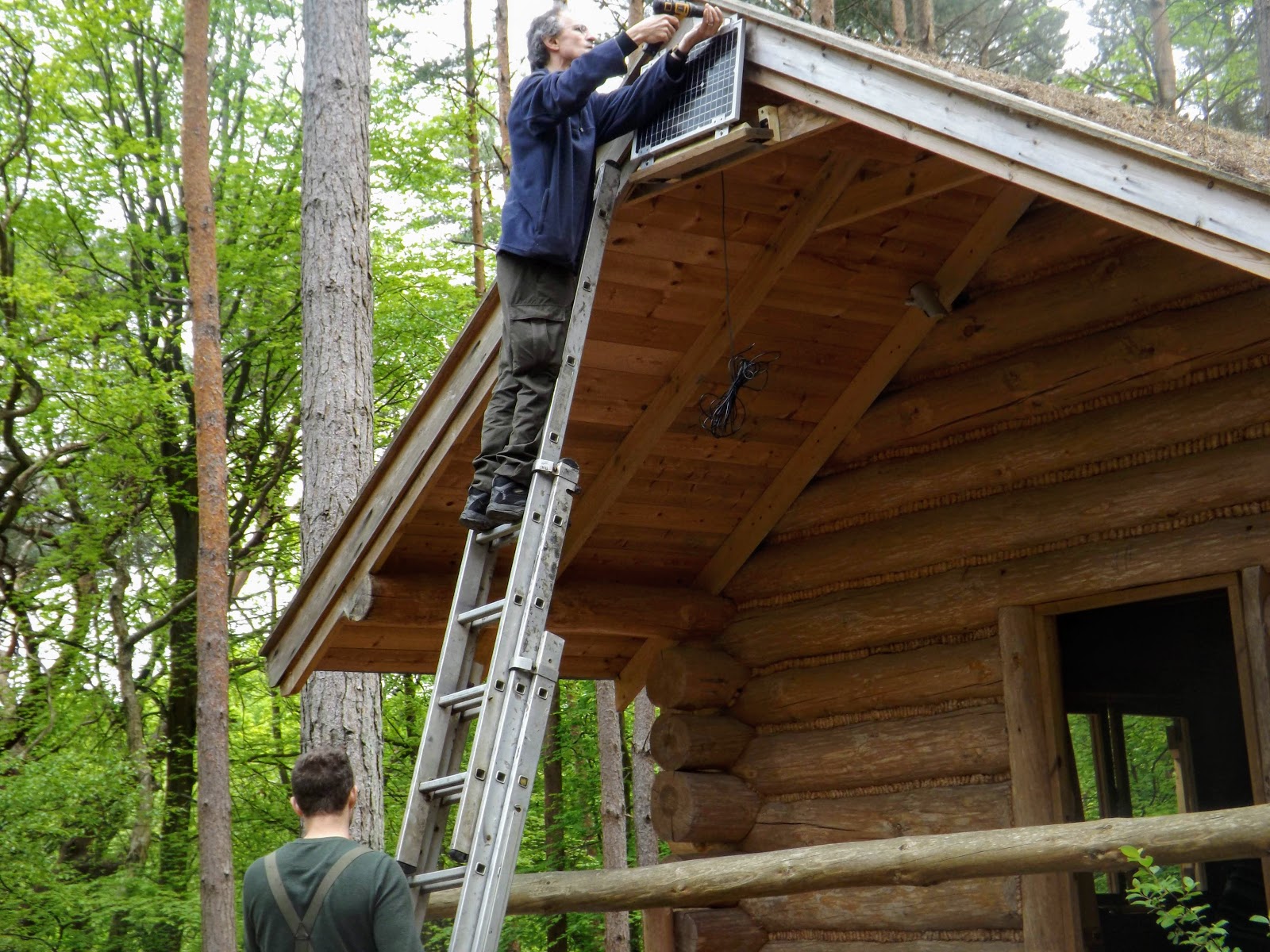
Cabin upgrade. Since the cabin was built in 2014 we've been meaning to install a modest solar system and now it's done and we have light at the flick of a switch -  what luxury.


A second huge branch fell off one of our veteran beech trees. It must have happened very recently. The first huge section fell down last year, and as it was now seasoned the work party made a fast job of cutting up the timber and winching it up to the Ride.  


The inside of  the branch that broke away from the main trunk to reveal the ancient, rotten wood .


Plenty of Beech fire wood for next winter


             As ever, many thanks to Mark and his team for all their much appreciated hard work. 


Monday, 8 April 2019

The hazel grove

We had always intended to extend the hedge to continue south and west from the bottom gate in OC1 down to the fishermen's gate, to form a continuous boundary. As explained in this post in January, when scoping it out, we realised that we had a much bigger and more exciting project on our hands.

We're going to try and create some suitable habitat for dormice. Petra's dormice boxes are untenanted, probably because there isn't enough food or cover for dormice. The new hedge will provide additional food (berries, shoots etc), but the hazel needs to be taken in hand (coppiced and/or pollarded) to make it more productive. But first the holly needs to be tackled as it has badly overshadowed the area.

Shade from the holly makes everything grown tall and spindly
This could be lovely
   Henri, Andy, Felix and friend came on the first Sunday in April to help do some holly bashing. Good progress was made, but there is a LOT of holly. This will be an ongoing project for the summer. An application has gone into Sussex Lund for a small grant to pay for the hedging and some additional hazel whips to extend the area.

Child labour enjoying a bonfire


Sunday, 31 March 2019

Filming the bees

Kryzstof the bee man came on his usual weekly visit to check the hives, but accompanied this time by two MA students who are making a film about the relationship between man and bees. They had to wear all the bee protection, as they got very close to the hives to record them.
Getting ready to film 


Grainy picture taken from far away - I'm not getting in too close
Photo of Old Copse hives from Kriss's Instagram account
Kriss inspecting the bees - from Kriss's Instagram account
As ever, Kryzstof wonders what food sources bees find in the wood.  They are clearly finding a lot, but it's not obvious what. The trick is to look up. At this time of the year all the activity is happening on the tree tops, where they are in full sunlight. For example, the wild cherry are blossoming like crazy - but the flowers are hard to see, and even more difficult to photograph on a phone - but the bees love them.

There's some cherry blossom way up there

And of course the wood is full of catkins for the bees to collect pollen from to feed the developing brood. The birch flowers early. The flowering season lasts for several weeks, as the tops of the trees flower first, and the branches in shade bloom a lot later. While birch catkins are full of pollen, they don't provide any nectar, which the bees need to give them the energy to fly.  But as I learned here willow catkins provide both pollen and nectar, which explains why there is so much bee activity in the willows.

'.
Birch catkins on the ride
The other thing I learned was that the word catkin comes from the old Dutch kat-e-ken, which means 'kitten'.