Friday, 1 August 2014

Warabimochi


I'm a bit excited because I've discovered that there might be a market for the bracken infestation I keep going on about. I emailed  a  Japanese friend some  photos of the cabin, and she was very interested in the bracken she saw in the images. I can't recall eating warabimochi when I lived in Nagoya for some months, but I'm sure it's oishi! (delicious)  Also very popular in Korea, the delicacy is made from bracken roots which are starchy  and formed into jelly like balls. These are served chilled, and before eating are  dipped into kinako  - sweetened, toasted soybean flour. Petra (see previous post) mentioned that she had heard of someone who has started exporting bracken roots to Korea - I wonder why - is there a shortage of bracken in Korea and Japan?  Anyway, further investigation is planned. Yoshiko is visiting from Japan later in August, and she wants to see the wood so perhaps I will learn more about it then.

Silver washed fritilleries flew around Sarah today as she was processing felled birch on the OC 2 Ride in the sun. 

Tuesday, 29 July 2014

'Official' Visitors


To the wood to meet Petra Billings  (Author and West Weald Landscape Project Officer for the Sussex Wildlife Trust), and Jim Smith-Wright,  (Low Weald Ancient Woodland Restoration Officer for the Woodland Trust),   representing a 5 year Lottery funded joint initiative  which aims  to encourage, advise, and where possible, offer support to small wood owners in the effective management of their  woods. They were accompanied by Keith, a research volunteer for the Woodland Trust, and 'Bear', Jim's  large and beautiful dog.

We spent almost 3 hours walking round 30 acres of Old Copse to see what progress has been made in 5 years and to discuss future plans, followed by refreshments at Old Copse HQ , (aka the log cabin).

 We've gained a reasonably good idea of our approach to woodland management, and as we progress, we grow in confidence in what we hope to achieve. Our visitor's specialised knowledge was much appreciated, and we took note of further improvements they suggested such as:  selective  ring-barking of some Scots Pine for standing dead-wood;  birch coppicing as we get to grips with thinning the birch ; improving bio-diversity on the Ride by mowing it during late August/early September each year,  leaving a margin of longer grass at either side;  advice on the placing and building of a wild-life pond near the cabin; We've also been promised  some dormouse nesting tubes next Spring, to monitor any resident dormice.

 Valuable  as their practical and theoretical knowledge is,  their link to what's  happening in the wider woodland environment in terms of contacts, grants and initiatives, meetings and so on,  is equally important.

 'Thankyou for a thoroughly pleasant and interesting stroll around your woods, and in particular,  tea in your idyllic log-cabin! Great to see woods being so well looked after and cared for.'  (email from Jim). 

Thankyou Jim and Petra.


Monday, 21 July 2014

Cabin in the Wood Officially Opened


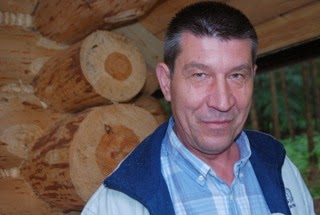
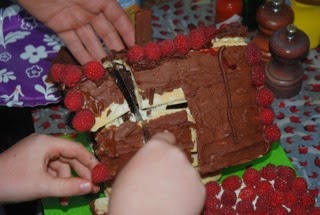
The cabin was officially opened in June, and the celebration  attended by a discerning group of woodland cabin enthusiasts. Enjoyed by all  despite the heavy showers - though  these  meant that the deck was fully utilised for shelter, and we had a good excuse to light the log burner,  which showed off how cosy and warm the cabin will be when it's not summer. The cabin,  Krysztof's skill, and the setting overlooking the Pond,  were much admired.  A large quantity of sausages were cooked on the open fire, and the cabin cake -  chocolate with raspberries and strawberries from the garden, went down well, as did the beer, especially the Polish Tyskie.


Wednesday, 2 July 2014

Ride-side thinning


Just completed quite a large section of the Old Copse 2 Ride that was choked with holly and birch, and so dark that nothing could grow underneath it. Unfortunately a 'before' picture wasn't taken, so must remember to do this next time. Now the fledgling oaks, beech, rowan and cherry can stretch out and grow properly. There is also a very impressive Scots Pine that escaped the 1987 storm, and with a bit more clearance around it will soon  be seen in all its glory. The site is now cleared of timber and tree tops, and the logs stacked on bearers to season for a year, and sell, or, preferably, to barter. We have learned the hard way to be properly businesslike about the sale of firewood, as our first contractor removed several cords, damaging the Ride in the process, and then 'forgot' to pay us.


Navvying continued


Sarah completed the digging out of the ditch, a distance of about 25 metres. Very hard muddy work. It was watched anxiously at the first downpour, and it worked well - the run-off finding its way along the ditch and through the newly cleared drain. Success, though a few more metres still needs to be dug, and a further 'French' drain is planned for further south on the Ride at a particularly boggy point.  

Thursday, 26 June 2014

A morning at the Charcoal Burners.


Recently,  we went to a farm in Elstead  Surrey for a (very) hands on crash course in how to make charcoal. Ian is a woodsman who spends the summer producing charcoal , and the winter  coppicing and felling. It is a surprisingly simple operation, and you don't even have to be picky about the type and size of timber put in the kiln.  Ian uses mainly chestnut, with plenty of birch, and soft woods like Scots Pine, to a ratio of about 70% to 30% . It took only 3 hours, including plenty of talk and a tea break to:

Empty the kiln of the previous 'burn' and bag the charcoal up for sale

Clear the air vents for the next burn

Re-fill the kiln with new timber

Start the fire with a bucket of burning charcoal

Get the new burn going well before putting the lid back on

Seal it with earth and let it get on with it for the next 30 hours or so.


It has to be said though, that it's a hot mucky job, so, afterwards, covered head to foot in charcoal dust we  jumped into the nearby river  to cool off . This washed the top layer off,  but a hot shower and lots of soap was the only way to get properly clean. In all it was a fun, informative and filthy morning's work. To be recommended.


Ian said that he can't supply enough of his charcoal to meet demand.  We thought that to make charcoal from our unwanted birch and Scots Pine might be an excellent  way to generate  income  towards paying for essential forestry work to meet our Management Plan targets. Old Copse was used by charcoal burners in the past, so it seems fitting that we might be able to  follow this tradition. First thing, locate a kiln........... 

Thursday, 19 June 2014

Going Hardcore

Labouring  continued:   we were kindly donated a load of builder's hardcore from a demolished wall, which was  delivered to Old Copse and left in a heap to be wheel- barrowed up the Ride. Composed for the most part of chunky broken brick it isn't as visually pleasing as wood or sandstone as a rut filler, but  with a top layer of Type 1, and a few weeks of bedding down, it should look ok, and by next year it will have sprouted a covering of grass. Sarah has been building her upper body strength with all this heavy work - all the better to get that chain saw started. Another bulk bag of type one to be delivered tomorrow - and hoping this should be enough to finish the job. No picture for this short blog item, because the subject was deemed to be just too boring to merit an illustration ............