Sunday, 31 May 2020

Deer Stalker Workday

The stalker's Old Copse workday was later this year because of virus restrictions. Twelve stalkers turned up, plus  multiple vehicles, a digger, a winch and other assorted kit -  an impressive team with  impressive machinery to tackle the day's work.

The first task was to make a secure home for the new second hand quad bike. The previous quadbike was stolen during the early days of lockdown when few people were about. Thieves cut the gate open, drove a truck in, used an angle grinder to release the quad, loaded it onto a trailer and made their getaway leaving the gate wide open. The police said that rural crime has increased a lot during the past  months.  The southern end of Old Copse is particularly vulnerable to unwanted intruders as it's easy to simply hop over the gate, or walk through the 'squeeze gap. The best we can do is to hide things as well as we can so as not to be a target for thieves. Mark was pretty laid back about the loss, only regretting not having got around to putting a tracker on the bike,  and  forgetting to cover it with camo netting so it couldn't be seen from the road. Anyway, another quad bike was purchased and a safer parking place needed to be found.

Building a new home for the quadbike

Having scoped out a suitable spot earlier the team dug out a space in the bank and lined it with timber. The new quadbike has moved into its new home and is not visible from the road. It's covered in camo netting,  has a tracker and is firmly attached to a hefty metal pole. Though, as Mark says philosophically, if someone sees it and really wants it, they'll find a way.

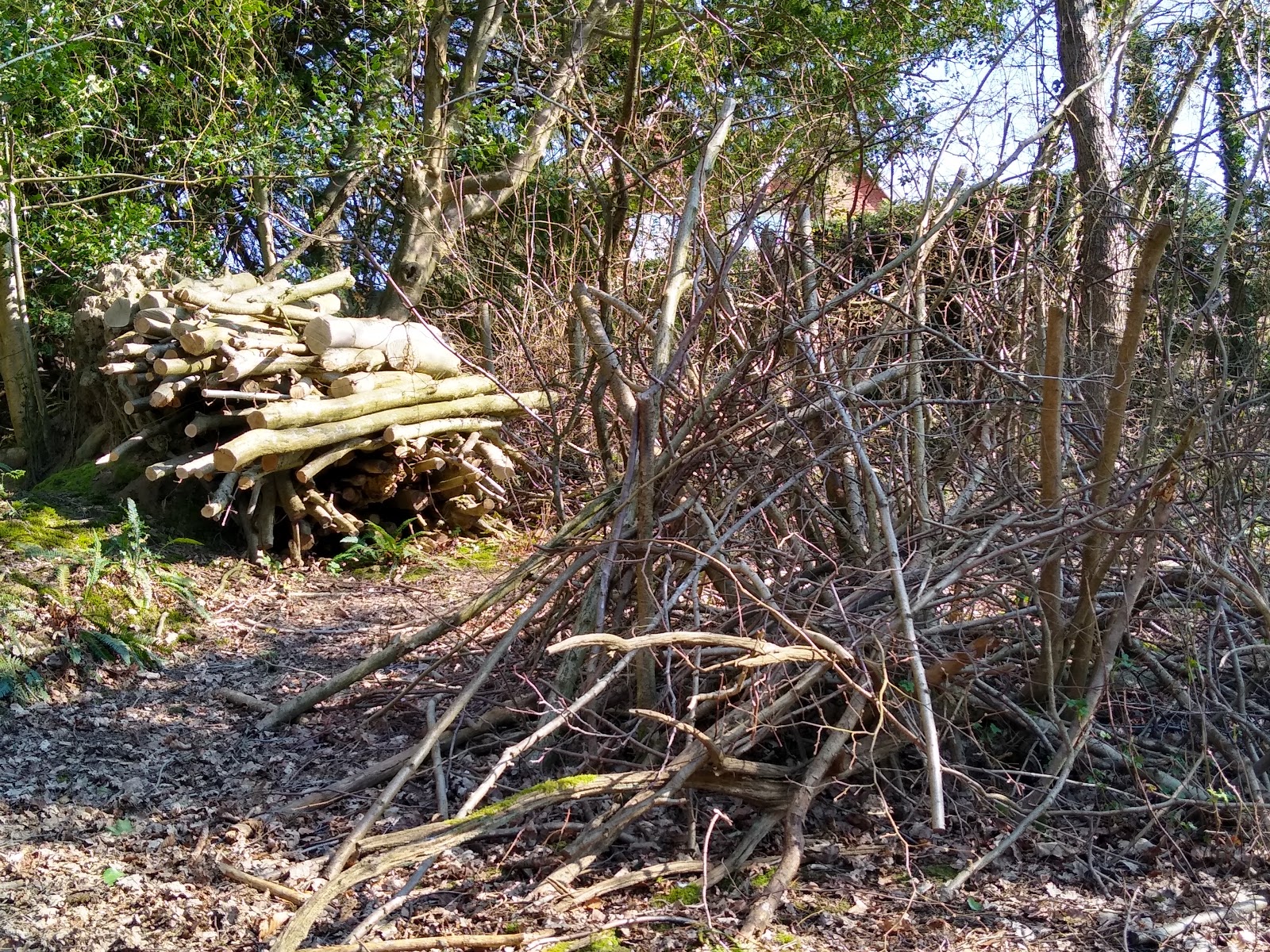
The other task was to build a wood store for all the felled timber scattered about the wood and needing a weatherproof home to season properly. This involved processing it in situ before winching and dragging it up steep slopes to the car park and then  filling the new store with it. I only saw it as they were finishing  and was surprised at how impressively  BIG it is! We hope the firewood it contains doesn't suffer the same fate as the quad bike but if so, we'll try to be as philosophical as Mark. 


An amazing amount of wood


We really appreciate having the deerstalkers' help, to manage the fallow of course, which over the years has made a great difference to our restoration of the wood, but also important, to do some of the  'heavy lifting' which the two of us just wouldn't be able to manage by ourselves. As ever, many thanks to Mark, Steve and the team. 

Taking a well-earned break


Tuesday, 31 March 2020

5 month catch up

Well, what a five months it's been. Our last post  was in celebration of Herbie's winning performance in  woodland.co.uk's 'Woodland Best of ' competition in the Best Woodland Dog category. This was posted on October 30th 2019. The rain had started in mid October, and was to continue until mid March 2020, making it extremely difficult to get much work done at Old Copse. What a very good thing it was to have the cabin to retreat to when the drizzle became a downpour. 


Basking in the Spring Sunshine, March 2020
                                       
Our main projects for the winter months were to do a modest amount of tree planting - no more than 100, and then to concentrate on the long neglected overstood hazel coppice at the south end of Old Copse. Sussex Lund supported this project by giving us a generous grant, and we planned to finish it by Spring 2020. Far too optimistic as it turned out. We underestimated the amount of hazel pollarding and holly felling needed.Our highly skilled and loyal forester who had helped us with our various Old Copse projects for eight years, announced that he and his wife were emigrating to Canada,  and sadly couldn't help us this time. So in between downpours we've been doggedly felling pollarding and clearing, on our own. There's still a lot to do but we've now stopped for the bird nesting season . Sussex Lund don't mind that project completion will be put back a year, so we're hoping for a drier 2020/2021 work season.

Some of the overstood Hazel waiting to be pollarded and protected from the deer 
                   
On the left a hazel and holly woodpile seasoning for next winter. On the right, a pollarded hazel protected from the deer. 
   
Tree planting also took a hit from the endless rain. We just managed to get the last of the tree whips in  the ground before the end of the planting season. The tree nursery was inundated by the heavy rains and were unable to lift and despatch them until a week ago.

Everything needed for a tree planting session: spade, stakes, hammer, tree shelters, stapler and a bag of trees.
 
A few wild daffodils together with primroses, lily of the valley and wood anenome,  have started to  spring up in new places in the wood, indicating that we're doing something right as we open the canopy and clear the bracken.

Last weekend's unusually strong north winds brought down another huge beech limb, which took out  a couple of scots pines as it fell. The result is a hung up mess which will need to be sorted out at some point.

A Scots pine fell and squashed a load of holly, which saves us a bit of work.
                     

There won't be much left of this Veteran Beech if any more limbs fall off.
                     
The surface of the wood is looking surprisingly dry, which seems strange after months of constant rain. We are just hoping that five months of  rain won't be followed by six months of drought, which would not be good for the prospects of new plantings, or the fruit and vegetable enclosure if we can't be here to water it. Which brings us to the final woodland fly in the ointment: the 'virus' and its effect on people's normal, everyday movements. At present we are still travelling to the wood, but soon we might not be able to do this. So the wood will have to get along without us. This isn't such a terrible thing as Old Copse will continue on its own without our help as it always does. But we would miss it very much.

Aah,  Spring again in beautiful Old Copse.
                 .


Wednesday, 30 October 2019

Herbie is a Winner!

Another award for Old Copse. This time it's for the best Woodland Dog. Many thanks to Woodlands.co.uk. We won a couple of years ago both for this  Blog, and  for our beautiful traditional  log cabin made from our own trees. Now it is Herbie's turn. He is borrowed from friends each week to accompany us to Old Copse. He completely enjoys the whole experience, and we love having him with us.

Though  he didn't get a rosette,  he's been enjoying his other prizes - bags of chews, and a useful collapsible travelling food bowl.  We did rather better on the prizes front, (sorry Herbie) with a woodland related book, a smart hardbacked notebook,  a Kelly Kettle, a sturdy canvas bag for log burner  kindling, a woodland themed  tea towel  and  tin mug, and lastly a fire steel which we will be trying out soon. 


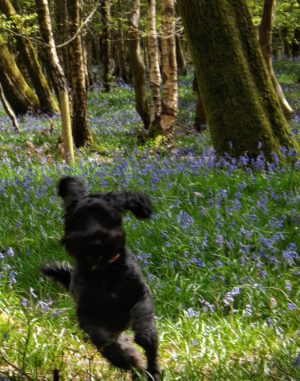
Here is Herbie a couple of years ago romping through the bluebells. A deserving winner!


Herbie, presented by Sue Davis and Sarah Axon

“Herbie the Cockapoo is used to the urban life but is a very enthusiastic woodland volunteer. Likes: sticks, digging, exploring, paddling, tracking deer, keeping guard. Dislikes: machinery, having to go home.”
 His favourite game at this time of year is flushing out pheasants. He has yet to actually catch one though. 

Sunday, 27 October 2019

Autumn is here

September has come and gone, with endless rain. While this has made more difficult the mammoth non- Old Copse project that has taken up almost 20 months of our time, the wood has enjoyed a good soaking. Even though it's mid October, the leaves are only just beginning to turn and some of the oaks remain stubbornly green.

Our big project  has kept us from doing much in the wood, apart from quick visits to restore our sanity. It really brings home how the wood operates on a different timescale to urban life. There really is no tearing hurry: the wood operates on it's own time frame. The growing season has finished and everything is now slowing down and preparing for winter.

This autumn has been marked by an astonishing crop of fungi - much enjoyed by the West Weald Fungus Identification Group who made their annual visit on October 16th. The purple web caps were the star of the show, and this year are growing in multiple locations. Up by the car park I found over 20 individuals. Full report to follow once Dick Alder has collated their findings.

Purple web cap growing on the ride

Much work remains to be done in the autumn, once time and other commitments permit.

There's still this fallen beech limb to process for firewood - it came down in July


There's work to begin on our planned hazel coppice for dormice
Not to mention more planting - trees to order and arrange to plant in OC2.

Looks like we'll be busy....

Saturday, 31 August 2019

A tale of two traps

It has taken me far too long to realise that most of the fine trail cam video that is posted on Facebook doesn't happen by accident. Those badgers and barn owls didn't happen to be just wandering past and decide to stop in front of the camera..Of course not! The space in front of the camera is baited with food - and the price of a free dinner is to have their photo taken. Up until now I've been using the trail cam to try and find out more about the life of the wood when we're not there. I've been interested in tracking the movements of deer and other creatures, and looking for patterns, rather than getting close ups.  The results have been informative - see this post from 2018 but not particularly visually interesting.

In the first week of August the camera finally caught a snap of the badger - the first sighting for a couple of years. I decided to change tack and see if I could get a better shot of him. I set up the trail cam as a camera trap with a lovely bucket of windfalls scattered on the ground in front of it, and waited to see if he would be attracted to a free apple meal.

Rare shot of the badger
Unfortunately, three buckets of apples later, all I have been feeding, are deer. I have endless shots of fallow - and the occasional roe - happily munching apples.

They scoff the lot as soon as we've gone, and leave none for badger who only comes out at night.


They bring the babies for a free meal.

Is there any more?

So I think I will stop this particular experiment, as we definitely don't want to encourage any more deer.

The other experimental trap is more lethal  - a high tech self-resetting squirrel trap. Despite the efforts of the stalkers, the squirrels are still shredding the beech trees, and so we've invested in a new trap to try and help keep the numbers down. The trap is new to the UK and was developed in New Zealand, based on the design of a successful possum trap. A small CO2 cannister powers a bolt which zaps  any squirrel who sticks his head in the cylinder to take the delicious chocolate nut bait. The dead squirrel falls to the ground and the body is scavenged by foxes or buzzards. A digital counter records how many times its been fired.


Well that's the theory. I've checked it every week and the killing counter remains stubbornly at zero. I thought I'd encourage the squirrels to find it by baiting the area around the trap, and have been scattering around a pound of maize kernels from the pet shop. These have been disappearing fast enough, but judging from the number of small holes nearby, I have been feeding - mice.

So not so much a tale of two traps as a tale of unintended consequences. 

Tuesday, 30 July 2019

Topsoil

Although July is a bit late in the season to start growing vegetables, we decided to get  the new raised beds filled with good quality topsoil  to be ready for some overwintering vegetables, and next year's planting season. It was delivered in huge bags on a very smart lorry with a crane attached. Using remote control the grabber lifted them from the truck and hoisted them into position. When in place the operator slit the bags to empty the soil directly into the beds. A fast and efficient operation with no shovel in sight.  Quite a spiffy set up - very impressive.

We planted out a few rows of tomato seedlings and some garden sorrel, brought from home. Both are now growing like crazy in the deep rich soil aided with all the hot sun and rain we've had. 


With concerns about the loss of the planet's topsoil in the news recently (much of it caused by deforestation) we were careful where we got ours from. See the link below:


Bury Hill black


Friday, 26 July 2019

Bats at Old Copse

The bats are a key part of life at Old Copse. One of the wood's great pleasures is to sit by the water's edge at the end of the day and wait for them to emerge as the light fades. They come whizzing out of the trees, zipping over our heads and swooping out over the pond. Although the fishermen told us these were Daubenton bats, we never knew if that was right or what other species were also there. So we were really pleased when Kevin Erwill of the Gatwick Greenspace Partnership and Martyn Cooke of the Surrey Bat Group agreed to come and spend a Sunday evening at Old Copse to help identify our bats.

Martyn arrived with some impressive kit; a large antenna sprouted from a backpack which turned out to hold a very sophisticated bat detector.

Bat detectorists

Down at a swim at the edge of the pond, after a bit of a wait the first bats came out - Soprano pipistrelles (Pipistrellus pygmaeus) and common pipistrelles (Pipistrellus pipistrellus). According to the Sussex Bat group both of these are widespread and fairly common in Sussex. Then as it got darker the Daubentons bats (Myotis daubentonii) came out to hunt across the pond. It was a real thrill to watch them through Martyn's infra red binoculars, which picked up not only the bats but their reflections as they flew over the water. It was a genuine privilege to watch and listen to something that's usually hidden in the dark.

This bit of film of Daubenton's from the Bat Conservation Trust (although not via infra red) gives an idea of what we saw.


By then it was almost pitch dark and we tried our luck in a different habitat, in the big clearing in OC1. Martyn's kit clearly picked up four more species:

  • Serotine - (Eptesicus serotinus) - uncommon, widespread in Sussex
  • Natterer (Myotis nattereri) - scarce, widespread in Sussex
  • Brown Long-eared (Plecotus auritus) - relatively abundant, widespread in Sussex


And even what he was certain was a Bechstein's (Myotis bechsteinii), a very rare bat indeed. And who are we to argue with an expert?

So that's seven different types of bats identified in a couple of hours. According to Martyn there are 12 species at Gatwick, so it's likely that there are more than seven at Old Copse. Maybe I'll invest in a bat detector...

Thanks to both. It was a great evening.