One of our largest beech trees, probably the largest in Old Copse, with a girth of 6 metres (19ft 8ins) measured at a height of 1.5 metres, recently dropped an enormous limb, 25 metres (82 feet) long. Lucky we weren't around when it happened. We wondered why the limb had broken off when it did and initially thought that it might have been caused by recent strong winds, but reading up on the subject, found that wind is highly unlikely to have caused the limb to part company with the tree. In the case of this particular beech, it might have been due to a weakness at the point where the branch joined the trunk, where fungus, evidence of rot, can be seen. Another beech, younger and smaller than our giant, and about 4 metres away, also dropped a limb, though there was no sign of rot.


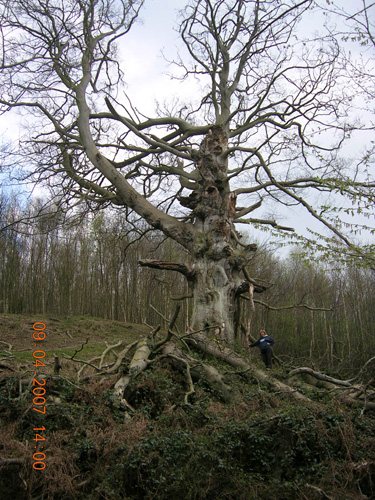
Below is a blog post (Ashley Peace mail@treeblog.co.uk) on the subject of why beech trees make a habit of losing their branches. The ancient beech tree in the photo is near Burwash in East Sussex. It is surprisingly, smaller than 'our' beech, which undoubtedley is younger than the Burwash tree, which is estimated at being from 200 - 250 years old. It certainly looks a lot older, and very gnarled. I expect, though, that trees, like people, shrink a bit as they become aged.
'The beech in the above photo is near Burwash, East Sussex. It displays clearly how the beech can drop its branches if need be. This one is in clay soil, on a steep-ish slope, about thirty metres above a tiny brook. The Woodland Trust guessed it must be between 200 and 250 years old. It is 220 inches in girth at 5 feet.
So, why would a tree want to lose its branches? It might seem like a ridiculous thing to do, considering the time and effort invested in growing them. Yet many biotic and abiotic stresses (e.g. water shortage or disease) may cause a tree to shed branches. However, given the size of this specimen, it is likely that simple old age is the causal factor - senescence. I believe the following article describes the whys and wherefores of geriatric branch shedding particularly well. I will reproduce it here in its entirety, The author is Peter Thomas (a lecturer in environmental science at Keele University (UK)), and the article originally appeared in the May 2002 edition of Natural History magazine.' (Ashley Peace)
To live long, a tree must stay small.
Old age is not the problem for plants that it is for animals. Being modular, plants can grow new limbs when old ones die off. More crucial to the longevity of a tree is its size. A tree reaches a stage when it cannot get taller, owing mainly to the difficulties of bringing water up from the roots, and when its side branches cannot grow longer, because they are too expensive to support. So the number of leaves a tree holds becomes more or less fixed, and this means that the tree's ability to produce food--the sugar made in leaves by photosynthesis--also levels off.
Yet each year the tree adds a new layer of wood under the bark, and the amount of wood needed to coat the whole tree increases, just as, in a set of Russian dolls, each new doll on the outside has to be bigger. As the tree grows, the amount of food needed for running it rises. The tree resembles a bank account whose income (sugary food) is fixed but whose outgo (respiration and new wood) keeps mounting. The tree compensates for a time by producing narrower and narrower rings, but there comes a point when a ring cannot get any narrower. Something has to give, usually the water-deprived top most branches. The result is a stag-headed tree, so named for the antlerlike dead branches sticking out of the top. A downward spiral begins: the loss of branches means fewer leaves, and fewer leaves means less new wood.
But many trees can slow the process. Some have buds in the trunk that sprout new branches. These may hold enough leaves to make up for those lost higher up, so the tree can keep the leaf area constant while cutting out the expensive-to-maintain upper trunk and its big branches.
Although these new trunk branches are fairly short-lived (a hundred years in oak, sixty years in hornbeam and beech, and less in birch and willow), an oak with plentiful trunk buds can stave off death for centuries. As the old saying goes: "Oak takes 300 years to grow, 300 years it stays, 300 years it takes to decline." Perhaps we should think of a stag-headed oak as merely entering middle age and, like many humans, just going a little bald on top.
A tree has no fixed life span. To live long, it must stay small. One way to do this is to grow slowly. Bristlecone pines are the supreme example: they live on poor soil in a dry, cold environment with a short growing season. One bristlecone in the American Southwest has been documented at three feet tall, less than three inches in diameter, and 700 years old! The other way to stay small and live long is, paradoxically, to be cut down repeatedly. (This strategy, of course, will work only for trees capable of regrowing when cut.) The ash Fraxinus excelsior normally lives for 250 years, yet Suffolk, England, hosts a coppiced ash with a stump almost seventeen feet in diameter. It is at least a thousand years old.
A tree's bank balance is also influenced by savings in the form of food reserves. As a tree gets bigger, however, it has less food left over. At the same time, the larder--the sapwood--gets smaller. Eventually, infections penetrate inner structures, and storage capacity is lost behind a barrier zone, a layer of new cells produced in the inner bark to seal off infected wood. The living part of the tree is walled into a thinner and thinner space under the bark. Part of the tree dies. New branches on the trunk can still save its life, but a large old tree is not good at producing new shoots, perhaps because it is running out of stored buds or because they are trapped behind thick bark. New sprouts on weak trees often die just when people think the tree is going to live. This may be because the barrier zone is missing or because there are too few reserves left for the tree to grow a strip of tissue from the new branch down to the roots. Either way, disease easily overtakes the tree, and the branch withers away. At this point, the tired old tree bows out gracefully.
Seen in the Wood Today: On the pond we were pleased to have a visit from a Grebe, a welcome sign of Spring. We don't know if he/she? is new to the pond, or just visiting from the Hammerpond nearby. A pair of Grebes live in the reeds over on the Hammerpond, but we don't know how successful they've been in raising a brood.


 Also seen; the first bumblebee of the year; and seen regularly by a fisherman on the pond, two kingfishers, one who lives down at the South end of the Pond, and the other at the North end. It seems that fishing rods provide an excellent perch for these birds to keep an eye out for minnows, so here's a library picture (unfortunately not taken on our pond).


 Also seen; the first bumblebee of the year; and seen regularly by a fisherman on the pond, two kingfishers, one who lives down at the South end of the Pond, and the other at the North end. It seems that fishing rods provide an excellent perch for these birds to keep an eye out for minnows, so here's a library picture (unfortunately not taken on our pond).