Sunday, 26 March 2017

RSPB Bird Survey

Marsh tit (library picture)

Willow tit (library picture)

Here is a slightly paraphrased extract from the report on a bird survey carried out by the RSPB in four wooded areas (including our Old Copse wood in the Sussex High Weald) during February/March last year. The surveyors were aiming to locate the presence of Marsh Tits and Lesser Spotted Woodpeckers.

Lesser spotted woodpecker (photo Steve Oakes)
Background:

Funding was secured by Natural England to undertake woodland bird surveys in 2016. The work was done in the following four woodland  SSSI's (Sites of Special Scientific Interest) in Sussex and Kent: Ashburnham; St  Leonard’s Forest/Old Copse; Cow Wood and Harry’s Wood; West Blean and Thornden Woods.  All four of these woodland SSSI's are notified for woodland and woodland breeding bird assemblage.

The field work undertaken aimed to:

• Check for presence of all resident woodland birds using appropriate survey techniques.

• Confirm breeding and breeding behaviour of key early woodland birds using appropriate
specialist survey techniques.

As funding was for the period prior to the start of the financial year in April 2016 breeding surveys could only be completed for those species that set up on territory early: namely lesser spotted woodpecker, willow tit and marsh tit. However, these are three of the most important woodland birds in a South East context. All three are rare and declining and all three require specialist survey techniques as they are unlikely to be recorded accurately using standard assemblage monitoring techniques. Surveyors also recorded the presence of other woodland birds during the survey.

As an additional comparison site the surveys of the area of Blean woods managed by the RSPB
are included.

Old Copse is Unit 1 (part) marked in purple . For the purposes of the RSPB survey, Old Copse was included as part of the greater St. Leonard's Forest area, which of course - historically -  it was.

 St. Leonard’s Forest survey areas (marked in purple)
Area: Unit 3: 2.08
Unit 4: 46.83
Unit 5: 9.21
Unit 1 (part): 5.6 (Permission to access larger area of Unit 1, in red, not granted)
Total: 63.72
Ownership: Unit 3: Forestry Commission
Unit 4: Forestry Commission
Unit 5: Forestry Commission
Unit 1 (part): Private owner - Sarah Axon

Three surveyors were used, all of whom had expertise in woodland bird surveys and a history of
previous work with the RSPB. The surveyors were Dave Burges (Ashburnham), Martin Allison (St Leonard's Forest and Old Copse, Cow Wood and Harry's Wood) , and Bob Gomes  (West Blean and Thornden  Woods.)

Report on St. Leonard’s Forest.(including Old Copse)

Dates of visits

In addition to the five dawn survey visits, a reconnaissance visit was also made on 11th February
so that the surveyor could familiarise himself with the layout of the wood. The dates and principal
objective of each visit is given in table 6 below.

Table 6. Dates and objectives of visits to St. Leonard’s Forest in February/March 2016.
Visit number Date Objective
1 11/02/16 Reconnaissance
2 16/02/16 Marsh/willow tit survey
3 02/03/16 Lesser spotted woodpecker survey
4 08/03/16 Lesser spotted woodpecker survey
5 17/03/16 Marsh/willow tit survey
6 21/03/16 Lesser spotted woodpecker survey

Target species

A total of 6 to 7 marsh tit territories were identified (Table 7). One territory (at TQ215309) may
have been just outside the survey area). Two of the territories were in Old Copse. They tended to
be in the wetter areas close to Gills or lakes (figure 7). St. Leonard’s Forest is a wet woodland
compared to sites further east such as Tudeley and Blean and it seems probable that this is an
important factor in the good numbers of marsh tits still present.


Table 7. Location of marsh tit territories at St. Leonard’s Forest based on five visits in March 2016.
Territory No Grid reference Location
1 TQ215309 Lily Beds
2 TQ208304 Sheepwash Gill
3 TQ212303 Scragged Oak Hill
4 TQ211301 Inholme Gill
5 TQ208300 Sheepwash Wood
6 TQ219294 Old Copse
7 TQ218292 Old Copse

No willow tits were found. Willow tit also depends on wetness but has a preference for younger
woodlands dominated by birch, hawthorn, willow, hazel and alder. It uses scrub vegetation of 2 to
4 m in height and is possible that this was not present in sufficient quantity on the site to retain
willow tit. However, it should be noted that willow tit has suffered widespread declines so it is
unlikely that its loss here is simply a site specific issue.

No lesser spotted woodpecker were found within the survey area. There are areas of St. Leonard’s
that are conifer plantation, some of it recently felled, which is less suitable for this species than
deciduous woodland. That may be a factor, especially to the north of the survey area. However the
south of the survey area included wet deciduous woodland that looked very suitable habitat. In fact
there was a record of a calling bird from outside the woodland boundary. It was heard on one
occasion south of the Hammerpond Road car park. It is possible that the southern part of the
survey area was in the territory of this bird but, at the least, its presence suggests that this species
might re-colonise St. Leonard’s Forest in the future if there is enough suitable habitat. Replacing
conifer blocks with deciduous woodland and increasing the quantity of deadwood would both be
beneficial for this species.

It is hoped that the survey will be repeated and developed in April, and July/August this year.  It will be interesting to know if our work done in the Old Copse wet wood,  birchwood, and the Scots Pine Plantation during the past year has had any effect on the Marsh Tit, Willow Tit, and Lesser Spotted Woodpecker population.

 Link to the full report:

Sunday, 12 March 2017

Photography

Recently, we saw a couple of  white and brown ducks  on the pond that we hadn't seen before. We tried to identify them but couldn't find anything similar in the bird books. Eventually we decided that they were domestic ducks who had left home to raise a brood on the pond. Despite looking very different to the mallards they were accepted and could be seen cruising up and down the water with them.

I had my camera with me one day, and while enjoying a cup of tea on the cabin deck I spotted our new ducks, and thought I would get a snapshot. More difficult than it sounds. By the time I got down to the Pond they had paddled away into the reeds. But it was lucky that I'd made the effort to try and get a photo because I stumbled, almost literally,  across Karl, who fishes on the pond, and is also a keen wildlife photographer, and who, like me, was trying to get a photo of these new visitors. Sitting quietly, waiting for a bite, he is perfectly placed to observe and record the local wildlife . We don't have much time to do this, and are usually making too much noise, so are very happy that Karl allowed us to put some of his excellent photos on the blog. Here are a few of them. Click on them to enlarge.


Two new visitors


.........and one of them with a Fallow Deer

 We do have rather too many of these pretty  Fallow Deer in the wood. 


Grass Snake


Kingfisher


Jay


Greater Spotted Woodpecker

Marsh tit (red-listed)


Bat, species to be determined , though we know there are Daubentons and Pipistrelles in the wood.


I think this robin has just spotted something to eat.

Not a rare Dormouse unfortunately, just a common wood mouse,    
sometimes known as the long tailed field mouse, but endearing all the same.
. 
Dragonflies (or Damselflies ) in flight. There are many  varieties, some rare, on or near the pond. 


Buzzard, with beautiful under wing markings.


Tuesday, 14 February 2017

Work in the Birch

We finished planting  in the Scots Pine in December, and since then have been working in the birchwood. After the Big Storm of 1987 knocked down a large part of the  Pine Plantation,  the fallen timber was removed by the Forestry Commission who owned Old Copse at this time. Birch, a plant of early succession,  soon colonised  the new space, growing tall and dense, with many spindly trees toppling over like a giant game of 'pick up sticks'. The result is a rather even-aged wood. Scattered through are a dozen or so larger broadleaves which have somehow survived both the plantation and the storm and are now emerging above the birch canopy.


While the birchwood in the southern part of Old Copse is not at all diverse, once we had thoroughly explored  the northern 15 acres  we found a surprising number of  oak and beech,  as well as rowan, hawthorn, hazel, and sallow.  So we are clearing space around these, and creating areas where we can encourage, and  plant a shrub layer , which at present the wood lacks. Already, this part of the wood  has started to have a native broad-leaf woodland 'atmosphere', a reminder of what it must have been like before the ancient woodland was cut down and replanted with Scots Pine.


There hasn't been any snowfall in the wood since the winters of 2009/10 and 2010/11, and even then it wasn't that deep and only lasted a couple of days but we had a little snow recently, just a dusting this time, but the air was frigid and mist hung over the wood and the Pond, making everything look almost monochrome.


In the recent cold weather we've been grateful for the cosy warmth of the cabin,  in the company of a phantom eyed Herbie , who always likes to monopolise the comfiest chair.


Friday, 30 December 2016

The end of another year

Yesterday, two days before the end of the strange year that was 2016,  we spent a few hours at Old Copse, not doing very much except checking in with the wood. We re-stacked lengths of birch firewood, heated up soup, toasted marshmallows in the  log burner,  and  'beat the bounds'. All the trees are now bare, and the bracken well and truly flattened, revealing the piles of  brash left after the thinning operation.  Mist rose from the pond, which was covered in a thin layer of ice.


And  while we walked we made a mental note of  the woodland management tasks we've achieved this year :

  • Started the year by 'mattocking' the deep, mud filled ruts made by the Scots Pine thin machinery.
  • Continued thinning the thick holly 
  • Pollarded the north side of the willow grove
  • Propagated successfully 50 trees and shrubs from seeds and seedlings found in the wood
  • Protected 100 regenerating trees from fallow deer
  • Planted over 400 trees in the thinned Scots Pine


and  then planned our woodland management tasks for 2017:

  • Finish planting in the thinned Scots Pine (January/February)
  • Tackle halo thinning in the birch wood  (January/February- August to November)
  • Spot replanting in the birch wood  (November /December)
  • Finish the holly thinning (by the end of 2017)
  • Pollard the south half of the willow shoots in the willow grove (November )
  • Plant a mixed hedge along the border with Grouse Road (December)
  • In  addition to these main tasks, there is bracken clearance from late May to September, fence mending and maintenance, monitoring deer and squirrel impact, continuing to protect regenerating broadleaves, ride maintenance, ditch digging ...


Several people have asked how the two  of us, visiting the wood on average twice a week,  manage   the work  necessary to restore Old Copse. I suppose it must seem like a daunting task to someone who isn't as familiar with the wood as we are, but we seem to have found a rhythm that suits us. We have recognised that we can't easily manage to do all the  'heavy' work ourselves, without perhaps losing momentum and  ending up feeling a bit overwhelmed. So we find people with woodland skills,  willing to help us in exchange for what the woodland can offer them. This approach  works well. We tackle what we can, and get help when we need it.


Management Plans are ok as far as they go, but they are usually written at the start of a project, and can only be based on what you know at that point. They are good for setting out the general direction and certainly, our aim, as stated in the original plan - to restore the woodland and improve diversity - has not changed at all. In fact the more we learn about Old Copse - the more determined we are to achieve this. As things progress we've found that we've modified our ideas, and done loads of work that isn't even mentioned in our plans. The Woodland Management Plan has been good for setting targets and has helped us keep on track. We have returned to it - and not just to put in grant claims to the FC - but to remind ourselves of how all the little tasks fit together into the bigger picture. Work doesn't stop after the end of a five year management plan;  on the contrary, work in the wood is never finished as the wood is dynamic and ever-changing. This might be seen as a bit dispiriting, but for me the sheer power of the wood to change and keep changing is one of the most wonderful things about it.

Wednesday, 28 December 2016

Old Copse 60 years ago: aerial photos

Thanks to Cambridge University Air Photos we can now see what Old Copse looked like in the 1950's. The first two photos below were taken in June 1953: note how the whole area is wooded right up to the field boundary in the north. The larger older trees (which show as darker) follow the banks of Hawkins Pond and the edge of the field boundary.. The lighter grey areas - particularly in the north of the two pictures - show what is presumably regrowth where the area has been unmanaged during the war years.


Taken 29th June 1953

Taken 29th June 1953

The next two photos from 1958 show the beginnings of the clearance in preparation for the Scots Pine plantation. The large trees at the field boundary remain, but south of that there are clear areas where felling  has started. The second photo from 1958 clearly shows how felling has begun along the line of Grouse Road.

Taken 26th June 1958

Taken 26th June 1958

Saturday, 10 December 2016

After the Big Thin - the big plant


Plumpton students after a day's tree planting and their tutor, Sarah George (far left)
It's now almost a year since we (or rather, David Abbott and his Sparrowhatch Forestry team) thinned the Scots Pine Plantation by around 30%. This  thinning process created  gaps which we planned  to plant with native broadleaves. Gradually, the Scots Pine plantation will be almost completely replaced by native broadleaf woodland. The next pine thinning operation will be carried out in about 4 years time.While we encourage  and protect any natural re-generation  that we find, this is a very slow process and much hampered by the deer population. Besides, there is something very satisfying in planting lots of trees for future generations.

We wanted to ensure the local provenance of anything we planted at Old Copse, and found two excellent suppliers: Special Branch Tree Nursery, based at Stanmer Park on the outskirts of Brighton, and run by volunteers.  Their seed stock is all sourced from Sussex, and grown carefully to provide quality plants. What Special Branch was unable to supply, we bought from English Woodlands near Heathfield, a commercial business which also guarantees good quality trees, mostly locally sourced.

As this was our first go at  major planting, we were advised and helped by David Abbott, one of our deerstalkers, who kindly took a day off from his own  business to show us how it's done. We also had help from a group of Countryside Management students from Plumpton College, and their tutor, Sarah George. Before coming to Old Copse they had studied our management plan, to understand what we are trying to do. Management Plans aren't obligatory for woodland owners but writing them really helps to focus on the work needed to restore long -neglected woodlands, and, also importantly, enables applications for grant aid. For instance, we were given a grant for writing the management plan, and also grants towards the work. So this, and some future tree planting projects are partly paid for by the Forestry Commission. Thank you F.C.

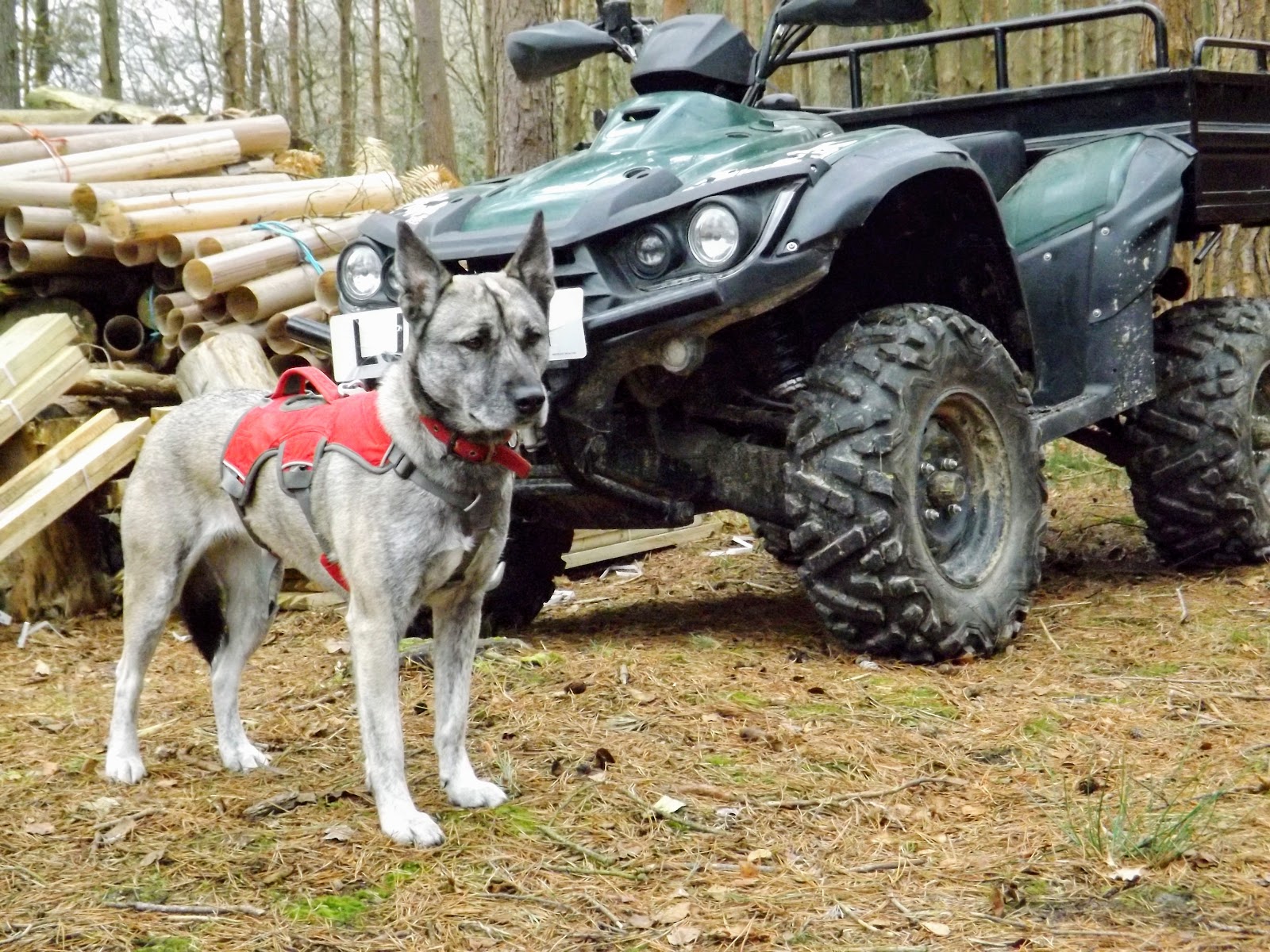
 All 30 acres of Old Copse will need varying degrees of  re-stocking  eventually, but we decided to begin with the thinned Scots Pine plantation  to see how we got on.  Some of the planting material, plus tubes, stakes and temporary deer-fencing was delivered by English Woodlands the day before, and we collected our plants from Special Branch a week before that. These had to be 'heeled in' to keep the roots in good condition, in the vegetable plot at home, then lifted and taken to the wood.  On Thursday morning David loaded up his quad bike and ferried all the heavy stuff down to the pines, ready to start planting our collection  of 400 bare-rooted whips, saplings, and potted young trees. We chose a mix of species, based on what grows naturally at Old Copse and would have been there before it was felled in the late 1950's to make way for the Scots Pine plantation  - primarily oak and beech. To these we added hornbeam, sweet chestnut, wild cherry, hazel, lime, and also guelder rose, spindle, dogwood, and a few of the rare native Plymouth Pear, thought to survive in just two wild hedgerows in Plymouth and Truro. Apparently it has an inbuilt control mechanism called self-incompatibility which prevents in-breeding  - it produces very little viable seed. (note to self: ask Special Branch where they got their seed from......)


David demonstrates
The first thing we did was to go round banging  in  loosely, 450 wooden stakes (an extra 50 in case of breakages). These were placed in small groups in the many gaps and clearings. Then the trees were planted next to each stake, more or less at random - which gives a natural looking result. The students were extremely careful when planting these tiny trees, making sure that the planting holes were the right size and the roots were carefully spread out before laying them carefully in the soil - all  essential techniques for maximising the success of their survival. Lastly the tubes, mesh for the beech, and closed for everything else, were placed over the top, the stakes banged in hard, and ties tightened. The pot grown, and larger rooted stock, had to be given larger planting holes than the specially prepared whips, which have much smaller roots. We're not exactly looking forward  to having a forest of green tree tubes to look at for the foreseeable future, albeit, thankfully not planted in regimented lines, but there doesn't appear to be any alternative. The tubes are supposed to be bio-degradable but I think they will take a very long time to completely break down. I can envisage us getting fed up with them and removing them before we should. Anyway, we'll have to forget the aesthetics for now, and hope that the trees will grow so fast, they'll burst right out of their tubes very quickly.

We managed to get nearly everything planted out before dusk around 4pm, leaving about 30 more in pots, plus some barerooted hedge and edging plants to finish up the next day. All in all, it was hard work but a very enjoyable, fun day, and so nice to work in a team with such great people. We reckon that we need roughly another 100 trees to finish this particular piece of work, but now we know the ropes, we'll get those in much faster, and expect to get the job finished during January.  We didn't need to use our 100 metres of heavy duty deer fencing this time, but it is sure to come in useful at some point. The next planting project will be in the birchwood after we've done some more felling there.


Sarah the tutor supervises

Herbie works hard, i..e races about like a maniac with all the excitement


While Wren guards the quad bike for David


And to end, a lovely email from Sarah, -  Countryside Management tutor at Plumpton College. I somehow think we'll manage to find a few more things for her students to do at Old Copse! Many thanks to Sarah and her students, and to David, for sharing his expertise, and who is, incidentally, an ex -student at Plumpton.


Hello Sue and Sarah

I just wanted to email and thank you for such a brilliant day yesterday.  The students absolutely fell in love with your woodland and were completely enchanted with what you are doing there and how you are doing it.  From my point of view, they learnt so much simply from working alongside you and David – far more than listening to me or reading from a book.  Your delicious soup at lunchtime just sealed the day – thank you so much.

As you  heard, many of the students are very keen to come back and see you again so if you have any further work  then please do let us know!

With warmest wishes

Sarah


And the result... 


Sunday, 20 November 2016

Today we were....................


Today we were mostly removing pollard shoots...............

We finished felling birch and pollarding the Goat Willow (Sallow/ Salix Caprea)   in the willow grove almost two years ago.  Most of the willow had grown tall and spindly and was toppling over. We needed to lower the overall height in order to maximise the chances of  attracting the Purple Emperor butterfly and more Marsh Tits back to Old Copse. We couldn't coppice it  (i.e. cut it down to near ground level) because the deer would have eaten it, so we decided to pollard it  ie. cut it down to about 6ft, out of the reach of the deer.

We don't know if  our work has attracted any Purple Emperors because we don't have time to spend sitting around with a pair of binoculars looking for them. But it's reward enough that we've made a nice attractive home for them if  they just happen to wander over from Knepp Castle eight miles away ( the nearest known colony of the Purple Emperor). Who knows, they just might have been tempted to make regular visits. We hope so anyway.


Pollarding willow is not the most enjoyable job. The wood is hard and springy, and the ground is squelchy and uneven. So we were pleased to have completed it last year, with the help of Martha and Milo, our two volunteers. However, work in the willow grove  doesn't stop after the initial pollarding. The new shoots have sprung up 15feet and more, some of them very thick, and they now need to be cut back to the main stem.

It is not the right sort of willow for weaving, too brittle,  and as far as we know it cannot be used for anything very much nowadays. Traditional uses included clothes pegs, and the foliage was used as winter feed for cattle. The wood also burns well and makes good fuel. Apart from the latter,  I suppose we could use it for dry hedging.  Aspirin is derived from salicin, a compound found in the bark of all Salix species, but I don't think that producing aspirin from Old Copse willow would be much of a money spinner, so nearly all of the prunings will be left on the ground to rot down.