Saturday, 30 September 2017

Strimmin'


We're strimmin ' strimmin' 
I wanna strim it with you
We're strimmin' strimmin'
And I hope you like strimmin' too
                                                                                   (thanks to Bob M)

Well, brush-cuttin' rather than strimming actually, with the new multi- tool, which has changeable heads that can do a multitude of woodland work. The problem with most bits of machinery is that they're not really made for lightish weight women under 5ft 4ins. The fuel tank adds to the weight, and the harness that supports it need a lot of adjusting to make it comfortable for the smaller person. But no doubt we'll  get used to it with a bit of practice Thankfully, starting it was easy.


First task was to tackle the timber storing area where the cut Scots Pine was stacked prior to collection during the Big Thin of late 2015.  After the logs, tractor, lorry and assorted machinery left, this space was a deeply churned up, rutted mudbath. It was difficult to imagine anything much growing there, but within 18 months a veritable meadow had appeared complete with grasses and wild flowers. It gets a lot of sun, and this summer found it buzzing with bees and butterflies. Keen to encourage this, and to maintain the grassland flora, we waited until the vegetation had set seed, and then today cut it all back. We'll remove the 'arisings' (woodspeak for the cut vegetation) when we next visit, and wait to see what the result is next Spring/Summer.  Autumn/winter is the time for attending to this as it allows a full life cycle of plants and associated insects to be completed.
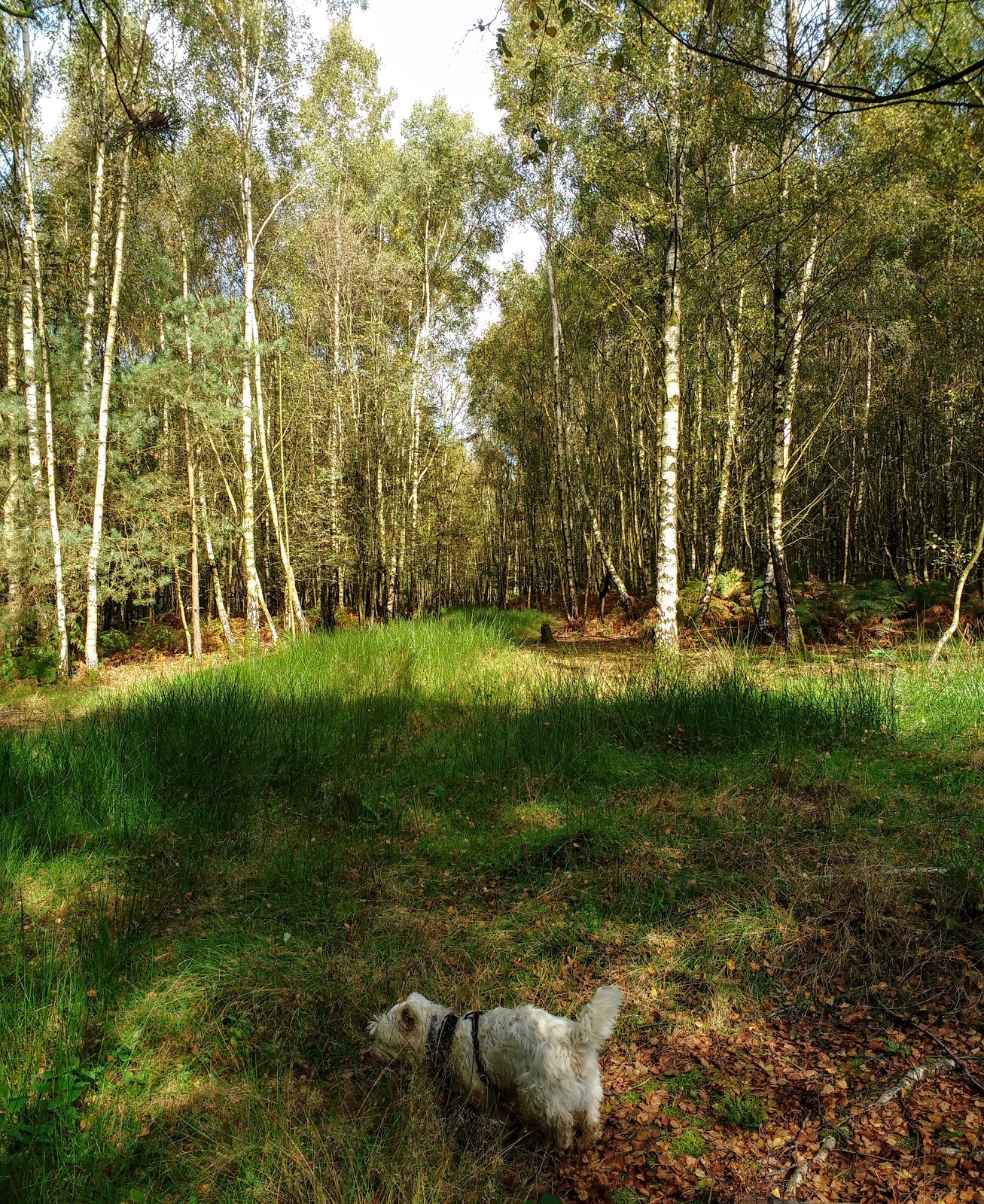

Next brushcutting job; the bluebell track through the birch.

George and Herbie off to investigate  what Sarah is doing.

Then, at the Ride edge, Sarah had a go at cutting back some tussocky tall grass,  and bramble that was spreading onto the Ride. Increased light levels have encouraged thuggish bramble, which though valuable for wildlife  can quickly take over and smother more delicate plants. We hope that judicious removal, combined with an ongoing programme of tree and shrub layer planting will in time, control its spread by shading it out.

The verdict after this first attempt, was that the rough vegetation needed the brushcutter head. The strimmer head just wouldn't have made the cut. Though I'm interested in trying out a push along cutter (aka a reciprocating scythe mower) that can tackle rough terrain.


Fly Agaric (Amanita  Muscaria) pushing its way out of the earth 


A fine patch of them in a sunny spot  on the edge of the wood


Sunday, 10 September 2017

Tree planting: growth update

We regularly check the progress of the trees that were planted last November/ December, to see that the tubes and stakes are still upright and secure from rampaging deer.  There have been  very few 'failure to thrive' saplings, and of those that have flourished in the 8 - 9 months since they were planted, the Hornbeams are winning in the growth stakes, closely followed by Sweet Chestnut. They've all burst out of their 1.5m tubes and some are now over 2m high. The hornbeam whips were 80cm-1m high and 2 - 3 years old when planted. So they've grown between 50-70cm in 8/9 months. Not at all bad, and perhaps due to a summer with lots of  hot sunshine and regular downpours.  The Wild Cherry are also growing fast, and some have reached the top of their tubes.  Not surprisingly the oaks and beech lag behind but even these have made slow but steady progress, and look healthy when we stand on tiptoe and peer down the tubes. The beech are in mesh tubes and can be seen easily. Other trees doing particularly well are our three Plymouth Pear specimens.

Hornbeam
These seem to be very easy to grow.  On average they reach 6m high and 4m across in 10 years and 25m x 20m when fully grown.  Ours appear to be growing at a much faster than average rate, in their first season at any rate.  They grow in full sun or partial shade and can tolerate any aspect or soil. The leaves provide food for many small moth caterpillars and the nut-like seeds are eaten by wood pigeons and the uncommon and elusive hawfinch. There were two Hornbeams in the entire 30 acres until  many more were planted last winter.

Flourishing hornbeam sapling with improvised tube extension 

Wild Cherry 
These can grow 35ftx25ft (11m x 7.6m) in 20 years, with a full grown height of 60ft (18m) Its Spring flowers provide an early source of nectar and pollen for bees, and the berries are eaten by birds including the blackbird and song thrush, as well as mammals such as the badger, wood mouse, yellow necked mouse, and dormouse. The foliage is the main food plant for caterpillars of many species of moth, including the cherry fruit and cherry bark moths, the orchard ermine, brimstone and short cloaked moth. There was one sizeable group of these in OC2, plus a few scattered individuals, and the new plantings will help distribute them better across the wood.

Sweet Chestnut
These are also fast growing,  long lived, and stately trees, usually growing to around 8 metres  after 10 years, and 35 metres  when fully grown, They can live for up to 700 years. We only have one mature specimen in the wood.  The flowers provide an important source of nectar and pollen to bees and other insects, and red squirrels eat the nuts - sadly we have only grey squirrels but I think they would enjoy chestnuts too. A large number of micro-moths feed on the leaves and nuts as well.

Plymouth Pear
This is a rare wild species of pear which was discovered in Devon in 1863. It's not a native to our wood, but is one of a small number of non local trees which we have planted for interest - and also because it's one of the rarest trees in the UK. There are only c 15 trees left in the original spot where they were found in hedge banks around the city of Plymouth.

Alder Buckthorn 
Mature trees can grow to a height of 6 metres. The outer bark is dark brown but the inner bark is bright yellow when exposed. It is the food plant of the brimstone butterfly whose caterpillars eat the leaves. Its flowers provide a source of pollen and nectar for bees and other insects and its berries are eaten by birds. It is 'widespread but rare'  says The Woodland Trust.


Alder buckthorn growing at the edge of the ride

 Quite a few of these were planted and protected last winter, since nearly all of the naturally regenerating ones were being enjoyed by snacking fallow deer. But to our surprise  numerous alder buckthorn have survived deer depredation this year.  Some of this success must be down to regular and well organised deer management, but also we think due to the large amount of brash left as a result of our Big Pine Thin of late 2015. Deer like an easy meal, and are reluctant to negotiate large amounts of woodland 'rubbish'  in order to reach a tasty morsel.  This has helped protect new growth, and now it's coming up all over the Northern end of the wood, where the majority of  felling took place. It's very welcome as it provides excellent shrub layer/understorey which we're very short of at Old Copse.


Friday, 1 September 2017

Cortinarius watch

Cortinarius violaceus   - on the west side of the pond

Yesterday (31st August) I decided to check on the progress of the original colony of Cortinarius v. on the west side of the pond, just up from the fishermen's bridge. The original specimens were now old and faded, but I counted six new fruiting bodies in the same area.
The original group - now faded 
New small purple fruiting bodies emerging
 As this seems to be a good year for this rare mushroom,  I went on a hunt to see if I could find anymore and checked all the places where it had previously been seen.

In 2013, I had previously found a single individual on the fishermen's path. Checking in the same area, I found four - terrific.
One of the four found on the fishermen's path at the edge of the pond

However, there was no sign of them up in the birch near the car park where we found them last year, albeit nearly two months later. I have noticed that they seem to prefer growing right at the edge of the trees where the light levels are comparatively high. It may be that with all the rain this year there has just been too much growth leaf growth in the area and not enough light is reaching the ground. It certainly felt cooler and damper in that spot than in the others where I found them

Finally, and completely unexpectedly, I found a single broken specimen growing on the ride in OC1 - a good 300m from the others.

Cortinarius violaceus found in OC1
Its position - right on the ride and under a birch tree -  helps strengthen my theory that they have an association with birch and require reasonably high light levels. The ones up from the fishermen's bridge are growing in a patch of birch only c 4m from the edge of the wood which gets a lot of light from the open field behind (now a vineyard).  The ones down by the fishermen's path are right at the edge of the pond and get a lot of light across the water. The ride itself is one of the sunniest places.

While it's probably just a good year for fungi, it would be nice to think that our work thinning the wood and increasing light levels is helping this rare mushroom to increase.

New Cortinarius site - on the ride under a birch tree in OC1
Update: 23rd September there were seven specimens of varying ages in the colony by the fishermen's bridge. I also found five growing in the birch near the car park where they were found last year. Plus while there were none on the ride under the birch tree (see above) I found two specimens in the adjoining birch wood 15ft away down the slope, which are presumably part of the same group. And for good measure one sole Cortinarius growing on the side of the ride in OC3. So an excellent year for them!

Update: 29th September - Cortinarius tally:
Fishermen's bridge colony - 4 specimens
Car park colony - 2 x groups, 2 + 4 specimens
Fishermen's path colony - 8 specimens (including two new)
OC1 rideside birch - 2 old specimens
Plus I came across three individuals in the OC1 birch to the east of the quarry - at least 50m from the ones previously spotted

Wednesday, 23 August 2017

Autumn fungi come early

Cortinarius violaceus - purple webcap (rare)
It's been a strange season for fungi. The summer fungi were very late - appearing only momentarily - yet the autumn fungi are everywhere, and we're only in the third week of August.

These purple webcaps were found growing on the east side of the pond, just up from the fishermen's bridge, so they're not strictly within our boundaries. However it's good to see this rare species making an appearance again. They don't seem to appear in the same spot twice. These ones are over 200m away from where last year's specimens popped up. The only similarities I have noticed is that they seem to grow in proximity to birch, and are more likely to grow near a path or near the edge of the wood where there is less shade.


Russula delica
These russula are typical of the many currently showing in the wood. These were found right at the roadside fence , growing through the leaf litter . Now these ones do come up in the same spot every year. They are very noticeable due to their size and the sheer force with which they push their way out of the ground, heaving aside the pine needles.


Amanita fulva - Tawny Grisette
Several members of the Amanita family are common in the wood - Amanita rubescens, Amanita muscaria (fly agaric), Amanita citrina (false death cap) Amanita excelsa and Amanita fulva (the tawny grisette) pictured above. They are all reasonably easy to identify as Amanita, due to their egg like appearance when young and that they often have a bag like 'Volvo' at the bottom of their stem. Distinguishing between different members of the family is more difficult, especially between pantherina and excelsa, which are both basically brownish mushrooms with spots. The grisettes are still the same family, but have a cleaner appearance, with a smooth stem. They are supposed to be edible, but I don't expect they taste of much. The picture above shows both the young and the fully grown specimen. There is a useful Amanita key here.


Crepodotis mollis - soft slipper toadstool
Finally, this one is a new one for me. Soft, damp and curly, the brittle fungus grows on decaying wood. The photo shows one which was part of a group growing on a dead rowan tree lying on the ground.  Crepodotis mollis - its common name is the soft slipper toadstool, which I can't quite see, but it was definitely soft to the touch.

Monday, 7 August 2017

Grant Aid

Earlier this year we put in an application for funding for a roadside hedge which will run about 625 metres from the northern end of Old Copse. We have just heard that we were successful in gaining funding, and are very pleased that our ideas have gained support. We aim to plant an informal hedge of native species along this eastern boundary . At present there is only  a single and rather ugly 4’ high wire fence between the wood and the roadside verge. 25 years old now, it needs constant repair. It adds nothing to the diversity and is not even an effective barrier. We regularly get garden waste dumped over it, giving rise to non-native species taking hold, which must be removed. Denser roadside planting  will help to discourage this. Photos below, taken last Spring,  give an idea of the current bareness of the roadside boundary.


.

We want to supplement existing sparse growth of honeysuckle and bramble with plants from the  shrub layer such as hazel, holly and hawthorn,  to create a more natural barrier along the roadside length of the wood. This planting will use the old fence as a support, and as it grows and thickens will greatly enhance the diversity and visual appeal of the woodland edge. It will provide valuable new habitat and food for birds and small mammals, both in the hedge and the adjoining woodland and contribute some much-needed understorey. The hedge will be an effective visual and sound barrier from traffic, and help prevent littering and fly-tipping. It will also look a great deal better than a wire fence.

So, many thanks to Sussex Lund for providing the funding for our hedging project and supporting our ongoing work of restoring  Old Copse.


We could have applied to the Forestry Commission for  funding for the hedge but decided to ask Sussex Lund which specifically funds projects in the Sussex Weald.  This was partly because we already have annual funding from the Forestry Commission  under the English Woodland Grant Scheme and  also because we wanted to establish contact  with other organisations.

We try and use volunteers to help us in the wood, and whenever possible people who can handle machinery  so that we don't have to. So far  we've avoided the need to buy expensive equipment.  The grant money we receive each year can be spent on re- stocking the wood with native trees. Though the plants are relatively cheap, costs soon mount up when  tree guards, stakes and rolls of wire  are included in the price. We  endeavour to keep these costs to a minimum , by making our own stakes and using recycled tree tubes as much as possible.

 Rampant growth this year due to the good summer and the increased light levels in the wood,  means that we are having to consider cutting and/or mowing the rides and glades to keep the bramble and other unwanted vegetation under control, and to encourage more diverse ground flora. We took welcome advice from Jim Smith-Wright, Ancient Woodland Restoration Project officer for the Woodland Trust . He suggested a number of machines to do the job,  from strimmers to brush cutters to  reciprocating, or scythe mowers which are a hand pushed alternative for level terrain. Jim also gave useful advice on the when, what, and how to cut , and what to do with the 'arisings'. The Small Woodland Owners facebook page is also useful when it comes to machinery, and a request for information always attracts a great deal of advice.  What we'll probably do is to try out a few alternatives either by hiring or borrowing a range of machines, and decide which one works best for us.

Tuesday, 25 July 2017

Photographing wildlife - or not

A quick Google image search brings up as many exquisite wildlife pictures as anyone could want. All I can say is that the photographers probably sat for three weeks waiting for the perfect shot. We've published some great photos taken by Carl the angler, as he sits quietly at a swim with his camera equipment and fishing rods, waiting for a carp to bite or an interesting bird or amphibian to come within telephoto range. Capturing moving wildlife with a mobile phone is much, much harder ...

Take yesterday, for example. While we were sitting at the cabin watching the rain, a large heron flapped south along the length of the pond. Determined to get a snap, I trudged the length of the pond to find him, without success. No sooner than I had come all of the way back, than he flapped past again, this time heading north. I set out to the top of the pond and found him up to his knees in the shallow water where the stream empties into the pond, fishing with great concentration.  Hiding behind a tree, I managed a quick snap. As soon as I moved to get a better shot he spotted me and flapped away.The result is below - another one for the series of out of focus pixellated wildlife.
The white blob on the left is the heron
The long grass up by the entrance car park is alive with butterflies: ringlets, gatekeepers and meadow browns. I thought they would make easier photographic candidates, but even they weren't simple. When one landed I would lean in for a photo, but usually they folded their wings, or shifted beneath a leaf. Or just flew away. However, half an hour's patience did produce a few shots.
Ringlet

Ringlet on a thistle
Gatekeeper

Finally, in case you're wondering, this what a heron sounds like when he is flying away from you.

Wednesday, 12 July 2017

In search of the Purple Emperor


Last week, on another blisteringly hot day, off we went to Knepp Castle, 8 miles from Old Copse, for a Purple Emperor Safari.

Knepp Castle is a 3,500 acre estate which the owners have been 're-wilding' from unproductive farmland since 2001. They are working with natural processes and have introduced Tamworth pigs, deer and longhorn cattle which roam across the estate.

Neil Hulme, Safari Leader and butterfly expert pointing out the goat willow (sallow), and what happens to former fields when left to their own devices 


Surrounded by willow scrub

We were hoping to spot a few Purple Emperors, and to learn more about their habitat at Knepp, so that we can do everything we can to encourage the butterflies into Old Copse, part of which was known to be a breeding site for them.  After the fields at  Knepp were left uncultivated, and the land was no longer subject to  herbicides, and fertilisers, goat willow scrub grew in abundance.  This clearly pleased the butterflies, which arrived  in large, and ever increasing numbers, much to the astonishment of  owners, workers, and naturalists, who had previously assumed that the Purple Emperor was a woodland butterfly. The Purple Emperor colony at Knepp is now the largest in the UK.

We had hoped to see the butterflies as they settled on the ground, where we could see their famous purple markings close up, but were told that they very rarely come down from the tree tops.  We soon found how difficult it was to firstly, spot them, and even more difficult, to take a photograph.

Luckily, one of the safari leaders had an excellent scope so we could see the butterflies in closeup....

There they are.......oh  missed them..........again

Purple emperor behaviour: thugs of the butterfly world, they will attack and see off creatures much larger than themselves, including birds and dragonflies. Lurking in the top of an oak waiting for something to invade their territory they will shoot out and scare them away. Often drunk on fermented oak sap, they also like to fight among themselves and will swoop and wheel in a distinctive movement, swooping and swerving at an astonishing speed........


See those blurry spots at either side of the picture? Purple Emperors on the attack


A female with her wings firmly closed
It's up there somewhere

They perch on leaves at the edge of a gap in the canopy - waiting to go on the attack

Zoom in (same photo) - that blur is a purple emperor

Purple Emperor egg on willow leaf (somewhat blurred)
At Old Copse we have worked hard to provide a space to welcome the Purple Emperor  but we don't have 3,500 acres to grow sallow in . This felt a little disheartening until Neil said that we probably do have the butterfly in the wood, though not in the large numbers to be found at Knepp, and advised us to put time aside to really look for them in the trees during their short summer season. Sallow does regenerate naturally, although most of the new shoots get munched by the deer. Also, we shall be thinking about planting a lot more sallow at Old Copse.

Neil has a starring role in a BBC Countryfile programme on the purple emperor. Watch here from c 47 mins in,