Saturday, 23 April 2016

Snake!

Spot the disappearing grass snake (clue - follow the dog's nose).

A 4ft long grass snake was basking in the Spring sunshine when spotted by Herbie.  Being a cautious dog, he sniffed carefully at its tail. The snake promptly uncurled and slipped into the safety of the woodpile, showing its fine striped markings as it went.

Monday, 18 April 2016

Spring on the pond

A clear Spring day. A film of green as the new leaves get going. Bluebells pushing up everywhere. On the pond the mallards are pairing up, squabbling to find partners and then retreating upstream for a little privacy. The moorhens are already building nests and quacking at anyone who comes near.

Tuesday, 29 March 2016

Signs of Spring at Old Copse

On a beautiful early Spring day we did a very rare thing, for us anyway, of not getting stuck into work immediately, but instead, just strolling round the wood to see what was emerging.  We checked out the wild daffodils at the south end and found about a dozen clumps, few flowers as yet, but they appear to be spreading slowly despite being in a dry and fairly shady area. Earlier in the day we had visited Newstead Ghyll, further up the road from Old Copse, where there are a great many wild daffodils growing in a damp, open clearing next to the stream.

For an expert's  view on wild daffodils,and other woodland flora, visit ecologist and botanist Alan Waterman's blog


Only a few clumps of wild daffodils at Old Copse

Though they can be found in abundance not far away


The wood remains very wet after months of rain - the annual flooding is receding  but water glistens and rushes everywhere.


We were hoping to find  a few wood anenomes and primroses but found none, except a few patches of primroses near the south gate, although they grow not far away in St.Leonard's Forest. Bluebells are forcing their way up through the mud and honeysuckle, mosses, ferns, Lords and Ladies have started to come up as well.


Also seen; the first bumblebee of the year; and seen regularly by a fisherman on the pond, two kingfishers, one who lives down at the South end of the Pond, and the other at the North end. It seems that fishing rods provide an excellent perch for these birds to keep an eye out for minnows,  so here's a library picture (unfortunately not taken on our pond).


We've had some success with propagating hazel
through cuttings, so today some more were cut , to be potted up and planted out in the autumn when they've rooted. A  holly, blackthorn and hazel hedge is planned near the new enlarged entrance, with more hazel planted along the bluebell ride through the birch.


.
.


.
Spot the Grebe - it can just be seen hiding in the reeds over on the Hammerpond


.

Monday, 7 March 2016

Weather

At 8am the sunshine was brilliant, but the forecast wasn't too good,  -  strong  wind, wintry showers, sleet, maybe some snow, perhaps some sun, but as Herbie the dog doesn't mind what the weather's like when a day at the wood is in the offing, and we didn't want to disappoint him, we decided to chance it. Forestry work takes place all through the year, but the winter months tend to be the busiest, especially for felling, so there's no point in  moaning about the weather, or using it as an excuse not to do any work .

As we drove north the skies became ominously dark and soon we were in the middle of a storm of wind blown snow and sleet. It only lasted 10 - 15 minutes, and by the time we arrived at Old Copse the sun was shining again.  That was the pattern of the day, - freezing cold wind, rain and sleet, alternating with brilliant sunshine. But it's great to see the wood in all weathers. You don't see weather in town in such a close up way. Today you could see the weather happening; the heavy showers were announced by darkening skies followed by strong gusts of wind which made the trees, especially the pines, bend alarmingly. Then the rain would come sheeting down.


So today we were right in the middle of the weather, getting tasks done when the rain held off and the sun came out, and then dashing for shelter to the cabin to watch another blast of  gusty rain and wind pass through the wood, while warming up at the stove and drinking tea. An exhilarating day.


We  love a wood burning stove on a cold day


Visitors: We met Martin (bird expert) between showers -  he is contributing to an RSPB  survey of Marsh Tits, Willow Tits and Lesser Spotted Woodpeckers who might (or might not) live in the wood. He had a tape of bird sounds with him, presumably to attract birds in the vicinity, but had to give up on this today because of the noise made by the wind in the trees. He is waiting for the next still, sunny day.


Sunday, 28 February 2016

Why do large branches drop off beech trees .


One of our largest beech trees,  probably the largest in Old Copse, with a girth of 6 metres (19ft 8ins) measured at a height of 1.5 metres, recently dropped an enormous limb, 25 metres (82 feet) long. Lucky we weren't around when it happened.  We wondered why the limb had broken off when it did and  initially thought that it might have been caused by recent strong winds, but reading up on the subject, found that wind is highly unlikely to have caused the limb  to part company with the tree. In the case of this particular beech, it might  have been due to a weakness at the point where the branch joined the trunk, where fungus, evidence of rot, can be seen. Another beech, younger and smaller than our giant, and about 4 metres away, also dropped a limb, though there was no sign of rot.


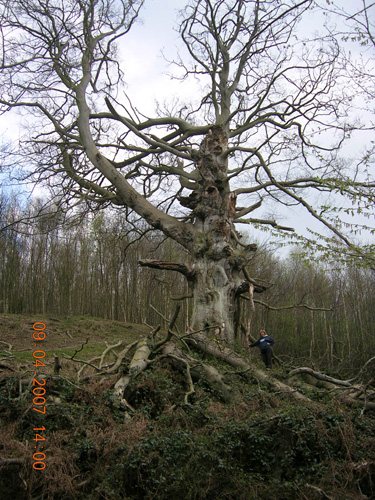
Below is a blog post (Ashley Peace mail@treeblog.co.uk) on the subject of why beech trees make a habit of losing their branches. The  ancient beech tree in the photo is near Burwash in East Sussex. It is surprisingly, smaller than 'our' beech, which undoubtedley is younger than the Burwash tree, which is estimated at being from 200 - 250 years old. It certainly looks a lot older, and very gnarled. I expect, though,  that trees, like people, shrink a bit as they become aged. 
  
beech near Burwash, E. Sussex (Tim Symonds)


'The beech in the above photo is near Burwash, East Sussex. It displays clearly how the beech can drop its branches if need be. This one is in clay soil, on a steep-ish slope, about thirty metres above a tiny brook. The Woodland Trust guessed it must be between 200 and 250 years old. It is 220 inches in girth at 5 feet.

 So, why would a tree want to lose its branches? It might seem like a ridiculous thing to do, considering the time and effort invested in growing them. Yet many biotic and abiotic stresses (e.g. water  shortage or disease) may cause a tree to shed branches. However, given the size of this specimen, it is likely that simple old age is the causal factor - senescence. I believe the following article describes the whys and wherefores of geriatric branch shedding particularly well. I will reproduce it here in its entirety, The author is Peter Thomas (a lecturer in environmental science at Keele University (UK)), and the article originally appeared in the May 2002 edition of Natural History magazine.' (Ashley Peace)

To live long, a tree must stay small. 

Old age is not the problem for plants that it is for animals. Being modular, plants can grow new limbs when old ones die off. More crucial to the longevity of a tree is its size. A tree reaches a stage when it cannot get taller, owing mainly to the difficulties of bringing water up from the roots, and when its side branches cannot grow longer, because they are too expensive to support. So the number of leaves a tree holds becomes more or less fixed, and this means that the tree's ability to produce food--the sugar made in leaves by photosynthesis--also levels off. 

Yet each year the tree adds a new layer of wood under the bark, and the amount of wood needed to coat the whole tree increases, just as, in a set of Russian dolls, each new doll on the outside has to be bigger. As the tree grows, the amount of food needed for running it rises. The tree resembles a bank account whose income (sugary food) is fixed but whose outgo (respiration and new wood) keeps mounting. The tree compensates for a time by producing narrower and narrower rings, but there comes a point when a ring cannot get any narrower. Something has to give, usually the water-deprived top most branches. The result is a stag-headed tree, so named for the antlerlike dead branches sticking out of the top. A downward spiral begins: the loss of branches means fewer leaves, and fewer leaves means less new wood. 

But many trees can slow the process. Some have buds in the trunk that sprout new branches. These may hold enough leaves to make up for those lost higher up, so the tree can keep the leaf area constant while cutting out the expensive-to-maintain upper trunk and its big branches. 

Although these new trunk branches are fairly short-lived (a hundred years in oak, sixty years in hornbeam and beech, and less in birch and willow), an oak with plentiful trunk buds can stave off death for centuries. As the old saying goes: "Oak takes 300 years to grow, 300 years it stays, 300 years it takes to decline." Perhaps we should think of a stag-headed oak as merely entering middle age and, like many humans, just going a little bald on top. 

A tree has no fixed life span. To live long, it must stay small. One way to do this is to grow slowly. Bristlecone pines are the supreme example: they live on poor soil in a dry, cold environment with a short growing season. One bristlecone in the American Southwest has been documented at three feet tall, less than three inches in diameter, and 700 years old! The other way to stay small and live long is, paradoxically, to be cut down repeatedly. (This strategy, of course, will work only for trees capable of regrowing when cut.) The ash Fraxinus excelsior normally lives for 250 years, yet Suffolk, England, hosts a coppiced ash with a stump almost seventeen feet in diameter. It is at least a thousand years old. 

A tree's bank balance is also influenced by savings in the form of food reserves. As a tree gets bigger, however, it has less food left over. At the same time, the larder--the sapwood--gets smaller. Eventually, infections penetrate inner structures, and storage capacity is lost behind a barrier zone, a layer of new cells produced in the inner bark to seal off infected wood. The living part of the tree is walled into a thinner and thinner space under the bark. Part of the tree dies. New branches on the trunk can still save its life, but a large old tree is not good at producing new shoots, perhaps because it is running out of stored buds or because they are trapped behind thick bark. New sprouts on weak trees often die just when people think the tree is going to live. This may be because the barrier zone is missing or because there are too few reserves left for the tree to grow a strip of tissue from the new branch down to the roots. Either way, disease easily overtakes the tree, and the branch withers away. At this point, the tired old tree bows out gracefully. 
                                                     

Seen in the Wood Today: On the pond we were pleased to have a visit from a Grebe, a welcome sign of Spring. We don't know if  he/she? is new to the pond, or just visiting from the Hammerpond nearby. A pair of Grebes live in the reeds over on the Hammerpond, but we don't know how successful they've been in raising a brood. 


Tuesday, 9 February 2016

Some thoughts on 'What are 'small' woodlands for'?


Woodland flower bed with antirrhinums and lavender.
The post that started the discussion.
A discussion last year on the SWOG (Small Woodland Owners Group)Facebook page got us thinking about what activities are part of managing woodland for conservation and biodiversity. A SWOG member was upset that many of the group appeared to be interested mainly in bushcraft schools, timber production, and building construction, whereas their prime aim should be the creation of a small nature reserve. He was particularly upset by another SWOG member who had posted a photo of his flower bed  fronted by a homemade hurdle fence, and backed by planted willow. It does look like something you might see in a garden rather than in a woodland . He was concerned about the introduction of non-native species into woodland, and the risk of non-natives taking over native plants, e.g. as is happening with native bluebells being ousted by 'Spanish' bluebells. In fact he frowned upon doing anything much in woodland, except say, to remove alien species such as rhododendron, and perhaps visiting for a little 'wild' camping, but apart from that, leaving it strictly alone.


The law  allows  a temporary caravan for the purposes of forestry,
though it doesn't look as if this one is moving at any time soon. 
You can camp in your woodland for up to 28 days a year
Making a woodland playground for children: good idea or not? 


But would this minimal intervention approach produce a 'nature reserve'. And what exactly is a 'nature reserve ' anyway? Will one just happen by not doing anything? Unlikely. Our current woodlands are the product of centuries of human intervention: pollarding, collecting firewood, grazing animals. And are woodland 'nature reserves' what is wanted or needed?

There followed a short Facebook discussion on what is ok to do in your own small patch of private woodland. Many people want to use theirs primarily for recreation and leisure, camping, and social get togethers, and a 'playground' for encouraging children to learn about, and enjoy the environment. Others are more interested in their gaming rights, and want to shoot rabbits, squirrels and deer, controlling all animals which could be seen to be detrimental to the regeneration of woodland habitat. Others are into machinery, though that begs the question of how much of that is really needed for these small bits of woodland.

But, as is evident from many of the postings on the site,  the majority of owners want to manage their woodland whether formally (via an approved plan) or informally. There isn't much evidence that owners intend to leave it alone to do what it wants. Traditionally woods were managed for both timber and for the useful products of the underwood - hazel poles and willow for hurdles. Regular coppicing let in light, allowing species to flourish, and increasing diversity. Changing economies mean that there is little use for coppice products in the 21st century, and the demise of traditional management has led to the overstood condition of many English woods. We know what happens to completely un - managed woodland - it soon becomes increasingly dark, dominant species take over, brambles and bracken flourish on the ground layer to the detriment of other light-loving plants - soon it becomes impenetrable. Nobody will visit it, nobody will take an interest.

The poster who started off the SWOG discussion seemed to be most exercised about the more commercial aspects of owning woodland, feeling that such activity is bad for the woodland environment. I don't think he needs to worry. Small woodlands are very unlikely to turn a profit. I've never heard of 'so and so' the charcoal burning, firewood selling, pole turning millionaire. It's entirely the wrong business, with perhaps the exception being those agencies mentioned below who sell off woodlands in tiny parcels. For the owner of a small patch, it might be possible to make a little cash, and obtain some public grant money for some equipment, and perhaps some deer protection etc, but it will never cover the cost of  labour. Though I don't think this bothers most owners. Even for PAWS (plantation on an ancient woodland site) owners like ourselves, 60 years after these were planted, the thinning operation costs almost outweigh any income from the timber.

Woodland bee-keeping
During the last 20 years or so, interest has grown, exacerbated by David Cameron's threat to sell off public woodland into private hands.This focused people's attention. As interest grew, a new business opportunity was identified. The company that hosts the SWOG facebook page set about buying up large-ish woodlands, tidying them up, putting in gates and access tracks, and dividing them into very small Lots of around 4 - 8 acres. These are then marketed at a premium price,. Many people are encouraged to buy their own small piece of woodland, albeit with neighbours, each with their own idea of how their plot should be managed, or not. No wonder then, that one owner wanting to put a nice little garden in his wood might then disapprove of his neighbour doing nothing, Where there is no cohesive management of the whole woodland, this seems likely to happen. 

This isn't necessarily a complete pessimistic outlook. Small woods are gradually finding their place, No longer an essential part of the village economy, small woods have become 'hobby woods' - places to enjoy and connect to the outdoors. What is clear is just how much pleasure they give their owners. By getting to know a piece of land through the seasons, closely observing the changes, owners - and that includes us - can't help but be inspired to preserve and improve what we have. We may all argue about the best way of getting there, but we are all united by a love of woods and a desire to see them flourish. 

All the illustrations used in this post are borrowed from the SWOG Facebook site. 

Some extracted quotes from the SWOG facebook page:

'.While we're aiming for a balance between a modest sustainable income and a wildlife friendly approach, not every woodland owner is motivated by future revenue and value . Amenity, education, and wildlife protection  are enough objectives for many small wood owners, those are also very worthy pursuits. As has been said before there are many different owners, woods and approaches, there's room for a diversity of views'  

Watching wild-life
'Just a warning. I have been a forestry contractor for 20 years and many small woodland owners have grown great big useless trees and then after 20 or so years have realised that this great big useless tree is about to fall over and destroy 20 others. Then they ask how much it costs to take the tree down. It normally stops there and the 20 trees get destroyed. My question is what is the difference to the wildlife in growing a good timber tree to a poor one. My second question is where is your sustainability. My third question is bearing in mind that since the ice age British man has been growing timber in this country which has built the wildlife around it. Do you think that changing the way you manage your woodland changes the wildlife? and if so why are you not carrying on what has been done in this country for over 7000 years'
Charcoal production


Keeping the home fires burning
'We have a management plan agreed with the forestry commission for managing different parts in different ways. The new planting will be thinned when appropriate. We do not just leave it until it gets out of hand. However, pruning off the side branches reduces the cover for small birds and also reduces the chance some will rot to provide holes. This has all been agreed. Other areas will be turned into coppice, the willow on a shorter rotation. The end product is an ecosystem and the by product is a selection of poles, firewood, wood for turning and crafts, and the occasional timber tree and hopefully a good number of veterans too. We are carrying on exactly as has been done for thousands of years with sustainable coppice plus continuous cover. It has worked very well so far. 

Willow grows all over the local area including all through our ancient wood because of the soil. We are only following what grows naturally. We will not need a contractor to help us. We have done all the work ourselves and are both qualified with chainsaws although we get professionals in to do any climbing and pollarding. We have been accused of over managing our woods by others on here. It is a fine balance. For our own land and objectives we think we have got it right. '

'My own approach is to work towards mirroring the medieval continuous cover approach, where there was always a mixture of trees ages and species, rather than a purely commercial modern plantation approach.

Saturday, 30 January 2016

In praise of the humble mattock

It's been a bit dispiriting at Old Copse this month. Mid-winter, post woodland operations, too much rain, gumboot sucking mud, and lots of repair work to do on the rides. Our contractors repaired the damage caused by machinery,by scraping the two rides. but inevitably, during this process, the excess squidge was moved to the sides, forming lava like waves of mud. In the pines the tractor carved out a pattern of ruts, which filled with water. We decided that to give the wood the best chance of a fast recovery we needed to smooth out the edges of the rides and to fill in the ruts. Perhaps, if we had left it to take care of itself,  in a couple of years we wouldn't know the difference. But we wanted to give the bluebells and other ground flora as much encouragement as possible. So, we set about repairs.

We decided that a particular tool was needed for this job. This tool was a mattock. It has different names in various parts of the world, and if you are ordering it off the internet, you need to look for an 'Azada digging hoe'.  You can forget about hi-tech solutions, in fact, I doubt there are any for this type of basic ground work. I believe that nothing works better for the job we have in hand than this ancient tool. It's unbreakable,  multi-use, cheap and simple. It's ubiquitous in developing countries, where it is a favourite with women  -  used for breaking up soil prior to planting, for hoeing, and on building sites for moving aggregates about. I've seen it in use in the paddy fields of S.E Asia,  in African villages, and in Indian towns and cities. Only £13 online. What a bargain.


First prepare and assemble your mattock; heat the metal part up in the oven, or on the hob to let it expand, then place the wooden  handle into the round slot provided for it, and bang into place with a hammer. Then put the whole thing into a bucket of water to allow the wooden handle to swell and form a tight fit with the metal.  It's then ready to use.

However, mattock use incorporates a particular technique. For our rut filling and flattening purposes we found that it's important to let  the weight of the mattock head do most of the work, and use your arms not wrists.  I clearly haven't yet mastered the technique because I have a slight case of mattockitis  at the moment. A bit like repetitive strain injury perhaps.

Here are some experts showing how it is done.


New bluebell shoots emerging - and it's only January
Last year, our new ride/bluebell walk  through the birch was looking promising, with lots of bluebells and other ground flora. After the tractor had been up and down it a few times we thought that there would be no hope of the bluebells making a recovery this Spring, but how wrong we were; with the unusually warm winter they are already making a comeback, shooting through the mud and the clay.


The wood is at its most 'bare' at this time of the year, with only pine and holly providing greenery, but it's  encouraging to see the effects of the Scots Pine thin. It's actually very difficult to remember exactly what it looked like 'before' . There still seems to be lots more to fell, but this will have to wait for another 5 years or so. In the meantime, our tree planting work will be going ahead, and should be well advanced. by the time the next  thin is due. What is already evident, is how much better the wood looks with the previously serried ranks of pines now not so prominent, allowing the sun to penetrate more. Also appreciated is the improvement in the view. We can now see shining glimpses of the pond to the South from the cabin.

A glimpse of the Southern end of the Pond through the newly thinned Scot's Pines
The view from the highest point of the new ride, looking across at St. Leonard's Forest