Monday, 29 May 2017

Glorious Spring

May weather has been a mixed bag, starting as it did  unseasonally dry and cold with a few night frosts  and ending with a mini -heatwave which broke last night with a spectacular thunder and lightning storm. I slept through it, so was a bit surprised to see that the garden water butts were filled right up. Today is muggy and  warm, with dense fog on the hills, and  drizzle. 

During the dry weather, growth in Old Copse seemed to have stalled, but with the downpours we've had recently, combined with the warmth , everything has burst into leaf. We can relax after worrying that our new trees wouldn't survive the summer. They have put on a huge spurt in growth , with just a few failures to thrive.

The established  beech trees are particularly lovely, their  almost  luminous, lime green leaves stand out from everything else and make us realise just how many there are in the wood. Not all the oaks are in leaf, which  indicates  that they have varied DNA

This is a photographic post ,  a  Springtime record of what Old Copse looks like in May 2017,  to enable us to compare with past and future years. To a casual viewer of this blog it could well appear that nothing much changes and it all looks the same from year to year , apart from seasonal differences. However, as frequent workers in the wood, we have every opportunity to observe changes, and to note what is doing well, and vice versa.


We've started opening up clearings and made a track through the dense birch wood

Each year there are more bluebells, and they are gradually spreading down among the thinned pine.

Grasses, foxgloves and ferns  are  colonising cleared ground 

The fallow deer have become very bold since the close of the season.

It's that time of the year again , Mark and his deer stalkers came in to do some heavy lifting.

And here they are taking a welcome break. Many thanks chaps for ........ 

Doing some tough holly clearance

.............and  processing, transporting, and stacking a large amount of birch firewood for next winter.


Recent sightings. Sarah was lucky : she disturbed a woodcock (red listed)  at the North end of the wood. It was taking cover under a beech tree in among the birch,  and later a tawny owl flew low over her head heading back to its roost in a large beech tree in the north of the wood.


Saturday, 29 April 2017

Springtime Regeneration


A new patch of Bilberry 

We've been hurrying to search out newly regenerating tree seedlings before the deer eat everything. It's a bit of a race against time. The fallow deer season ends April 30th, and after that it's the closed season until August 1st. So for three months they can run riot in Old Copse eating everything in sight, but especially the tender and tasty newly regenerating shoots.  There's been a lot of walking about these past few weeks looking for tiny seedlings to mark with tape before protecting them with recycled tree tubes and home-made hazel stakes. There appears to be much more regeneration than in previous years. This could be due to a number of reasons: the felling of Scots Pine and birch to let in more light;  the ongoing routine of  bracken bashing which prevents ground flora being buried in mounds of dead bracken,  and the gradual reduction in deer numbers .


Alder seedling in the 'wet wood'

Here are a couple of photos which show the difference made by bracken management. The first photo shows our 'control' area  in the Scots Pine plantation where the Pine has been thinned but no replanting or bracken bashing has been done. Note how dead bracken has smothered the ground flora - no bluebells or very much else can survive in these conditions. In contrast, the two other photos show a couple of areas where the bracken has been ruthlessly removed, and which were devoid of bluebells until this Spring.


We wrote about our spreading patches of wild daffodils in a previous post. Here are some more examples of regenerating ground flora:

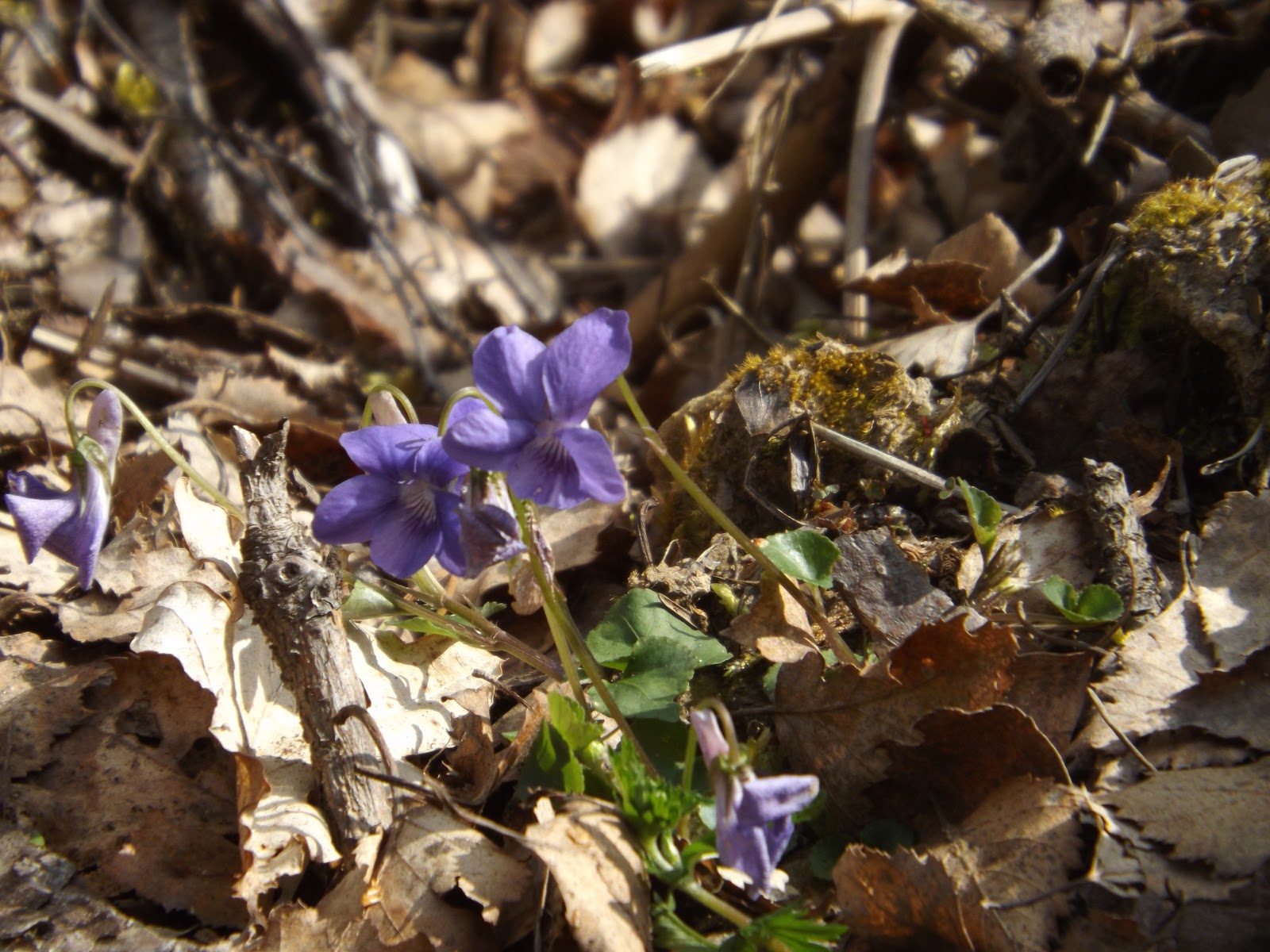
Violets 

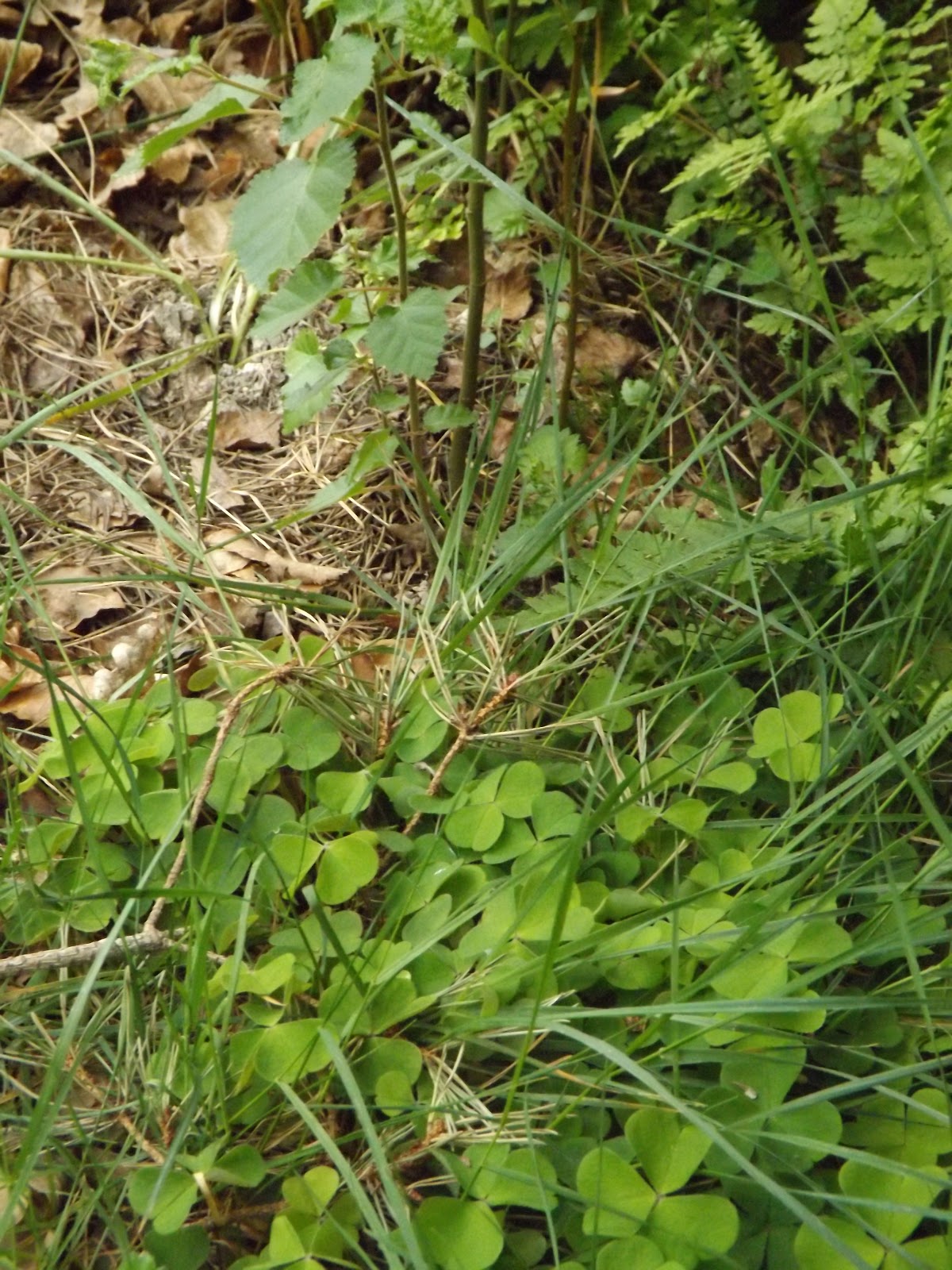
Just outside the cabin - ferns, wood sorrel, birch, grasses

New lush grass in a damp spot 

Rowan emerges in abundance and is usually eaten by deer, but we protect some we want to keep. We'll need to fit a longer tube on the rowan in the photo below .


A new patch of heather

Woodsage


Willow springing up next to the deck

We're getting much better at growing our own trees . Last December we came across abundant acorns at Wakehurst Place (National Trust/Kew Gardens), 13 miles from Old Copse. They looked especially large and robust, so we gathered a couple of handfuls and plonked them into small pots of compost , not really expecting much of a result. So we were very pleased to see them all successfully germinating and growing into sturdy young oak trees. We should have more than 40 to plant out next Autumn.


It has been an exceptionally dry Spring so far and we have been worrying about the survival of the 500 + tree 'whips' we planted last Autumn. But  under the dry pine needle and deciduous leaf  'crust', the soil is still damp. We would like a really good downpour though to get the trees through their first season. Both the willow grove and the alder wood are looking good, inhabited by marsh tits attracted by their dampness.


Willow pollards with shoots removed last winter. We pollard by rotation, a section at a time, so there's a variety of growth..

We came across a fallow deer corpse in the willow grove. We think it might have been injured on the road and made its way into the willow grove to die. Herbie was very interested, but also nervous about approaching it. After a bit he decided that the corpse wasn't a threat and  got closer to have a sniff. It was quite fresh - the buzzards, crows , foxes and badgers will make short work of it.


Thursday, 6 April 2017

Bufo Bufo

otherwise known as.....the Common Toad


These great photos of toads in Hawkins Pond were taken by Karl, three weeks ago in early March. Toads (and frogs) use Hawkins as a breeding site, returning every year to spawn. Apparently toads moved elsewhere will find their chosen pond even if they are more than two miles away. The mass migration to Hawkins has been watched by the fishermen, who have seen hundreds of toads assemble for the annual mating. Males arrive first and remain in the pond for several weeks, while females only stay long enough to mate and spawn. The female lays a long double string of small black eggs, which the male fertilises. The toadpoles hatch out after two or three weeks. There are thousands of them, but many will become food for the grass snakes who have now come out of hibernation and will hunt them in the water.  By twelve weeks the young toads will be ready to leave the pond.  They spend the rest of the year living in damp lairs, concealed under rocks or log piles, coming out at night to hunt. 

We've got plenty of log piles and are be careful not to disturb the inhabitants underneath with too enthusiastic tidying!


Thursday, 30 March 2017

Wild daffodils

Last week we were thrilled to see wild daffodils in a place they've never been seen before. There are a few long-established clumps down at the south end of Old Copse, which seem to be spreading, albeit, painfully slowly, and until last week, we thought they were the only wild daffodils in the wood.


The original wild daffodils 

So, it's very pleasing to see some new ones in flower just off the steep track through the birch some 500 yards further north in the wood. The seeds must have been waiting in the ground for a very long time, and once light had been brought in through some selective felling and clearing,  they had seized their opportunity.  Natural regeneration like this seems to make all our work worthwhile. Not only daffodils, but wild violets and other herbaceous plants are also starting to make an appearance in the ground layer, stimulated by the increased light  - and hopefully - better able to survive due to decreasing deer numbers.


Wild daffodils starting to colonise a new clearing.


Sunday, 26 March 2017

RSPB Bird Survey

Marsh tit (library picture)

Willow tit (library picture)

Here is a slightly paraphrased extract from the report on a bird survey carried out by the RSPB in four wooded areas (including our Old Copse wood in the Sussex High Weald) during February/March last year. The surveyors were aiming to locate the presence of Marsh Tits and Lesser Spotted Woodpeckers.

Lesser spotted woodpecker (photo Steve Oakes)
Background:

Funding was secured by Natural England to undertake woodland bird surveys in 2016. The work was done in the following four woodland  SSSI's (Sites of Special Scientific Interest) in Sussex and Kent: Ashburnham; St  Leonard’s Forest/Old Copse; Cow Wood and Harry’s Wood; West Blean and Thornden Woods.  All four of these woodland SSSI's are notified for woodland and woodland breeding bird assemblage.

The field work undertaken aimed to:

• Check for presence of all resident woodland birds using appropriate survey techniques.

• Confirm breeding and breeding behaviour of key early woodland birds using appropriate
specialist survey techniques.

As funding was for the period prior to the start of the financial year in April 2016 breeding surveys could only be completed for those species that set up on territory early: namely lesser spotted woodpecker, willow tit and marsh tit. However, these are three of the most important woodland birds in a South East context. All three are rare and declining and all three require specialist survey techniques as they are unlikely to be recorded accurately using standard assemblage monitoring techniques. Surveyors also recorded the presence of other woodland birds during the survey.

As an additional comparison site the surveys of the area of Blean woods managed by the RSPB
are included.

Old Copse is Unit 1 (part) marked in purple . For the purposes of the RSPB survey, Old Copse was included as part of the greater St. Leonard's Forest area, which of course - historically -  it was.

 St. Leonard’s Forest survey areas (marked in purple)
Area: Unit 3: 2.08
Unit 4: 46.83
Unit 5: 9.21
Unit 1 (part): 5.6 (Permission to access larger area of Unit 1, in red, not granted)
Total: 63.72
Ownership: Unit 3: Forestry Commission
Unit 4: Forestry Commission
Unit 5: Forestry Commission
Unit 1 (part): Private owner - Sarah Axon

Three surveyors were used, all of whom had expertise in woodland bird surveys and a history of
previous work with the RSPB. The surveyors were Dave Burges (Ashburnham), Martin Allison (St Leonard's Forest and Old Copse, Cow Wood and Harry's Wood) , and Bob Gomes  (West Blean and Thornden  Woods.)

Report on St. Leonard’s Forest.(including Old Copse)

Dates of visits

In addition to the five dawn survey visits, a reconnaissance visit was also made on 11th February
so that the surveyor could familiarise himself with the layout of the wood. The dates and principal
objective of each visit is given in table 6 below.

Table 6. Dates and objectives of visits to St. Leonard’s Forest in February/March 2016.
Visit number Date Objective
1 11/02/16 Reconnaissance
2 16/02/16 Marsh/willow tit survey
3 02/03/16 Lesser spotted woodpecker survey
4 08/03/16 Lesser spotted woodpecker survey
5 17/03/16 Marsh/willow tit survey
6 21/03/16 Lesser spotted woodpecker survey

Target species

A total of 6 to 7 marsh tit territories were identified (Table 7). One territory (at TQ215309) may
have been just outside the survey area). Two of the territories were in Old Copse. They tended to
be in the wetter areas close to Gills or lakes (figure 7). St. Leonard’s Forest is a wet woodland
compared to sites further east such as Tudeley and Blean and it seems probable that this is an
important factor in the good numbers of marsh tits still present.


Table 7. Location of marsh tit territories at St. Leonard’s Forest based on five visits in March 2016.
Territory No Grid reference Location
1 TQ215309 Lily Beds
2 TQ208304 Sheepwash Gill
3 TQ212303 Scragged Oak Hill
4 TQ211301 Inholme Gill
5 TQ208300 Sheepwash Wood
6 TQ219294 Old Copse
7 TQ218292 Old Copse

No willow tits were found. Willow tit also depends on wetness but has a preference for younger
woodlands dominated by birch, hawthorn, willow, hazel and alder. It uses scrub vegetation of 2 to
4 m in height and is possible that this was not present in sufficient quantity on the site to retain
willow tit. However, it should be noted that willow tit has suffered widespread declines so it is
unlikely that its loss here is simply a site specific issue.

No lesser spotted woodpecker were found within the survey area. There are areas of St. Leonard’s
that are conifer plantation, some of it recently felled, which is less suitable for this species than
deciduous woodland. That may be a factor, especially to the north of the survey area. However the
south of the survey area included wet deciduous woodland that looked very suitable habitat. In fact
there was a record of a calling bird from outside the woodland boundary. It was heard on one
occasion south of the Hammerpond Road car park. It is possible that the southern part of the
survey area was in the territory of this bird but, at the least, its presence suggests that this species
might re-colonise St. Leonard’s Forest in the future if there is enough suitable habitat. Replacing
conifer blocks with deciduous woodland and increasing the quantity of deadwood would both be
beneficial for this species.

It is hoped that the survey will be repeated and developed in April, and July/August this year.  It will be interesting to know if our work done in the Old Copse wet wood,  birchwood, and the Scots Pine Plantation during the past year has had any effect on the Marsh Tit, Willow Tit, and Lesser Spotted Woodpecker population.

 Link to the full report:

Sunday, 12 March 2017

Photography

Recently, we saw a couple of  white and brown ducks  on the pond that we hadn't seen before. We tried to identify them but couldn't find anything similar in the bird books. Eventually we decided that they were domestic ducks who had left home to raise a brood on the pond. Despite looking very different to the mallards they were accepted and could be seen cruising up and down the water with them.

I had my camera with me one day, and while enjoying a cup of tea on the cabin deck I spotted our new ducks, and thought I would get a snapshot. More difficult than it sounds. By the time I got down to the Pond they had paddled away into the reeds. But it was lucky that I'd made the effort to try and get a photo because I stumbled, almost literally,  across Karl, who fishes on the pond, and is also a keen wildlife photographer, and who, like me, was trying to get a photo of these new visitors. Sitting quietly, waiting for a bite, he is perfectly placed to observe and record the local wildlife . We don't have much time to do this, and are usually making too much noise, so are very happy that Karl allowed us to put some of his excellent photos on the blog. Here are a few of them. Click on them to enlarge.


Two new visitors


.........and one of them with a Fallow Deer

 We do have rather too many of these pretty  Fallow Deer in the wood. 


Grass Snake


Kingfisher


Jay


Greater Spotted Woodpecker

Marsh tit (red-listed)


Bat, species to be determined , though we know there are Daubentons and Pipistrelles in the wood.


I think this robin has just spotted something to eat.

Not a rare Dormouse unfortunately, just a common wood mouse,    
sometimes known as the long tailed field mouse, but endearing all the same.
Dragonflies (or Damselflies ) in flight. There are many  varieties, some rare, on or near the pond. 


Buzzard, with beautiful under wing markings.